Given the never-waning focus among classical music fans on established (and too-frequently, dead) composers, it would seem that the world of modern classical music is one of the most difficult to get a handle on – audiences are left unsure where to even begin, and composers themselves don’t get much attention or many breaks. Meanwhile, except for the occasional article devoted to film soundtrack work, the music press mostly ignores this genre entirely - perhaps due to the fact that numerous contemporary composers have adopted a “less is more” attitude when writing that has made their music largely inaccessible to mainstream audiences - but there is some sublime work out there provided one isn’t expecting the “1812 Overture” or “Beethoven’s Fifth.”
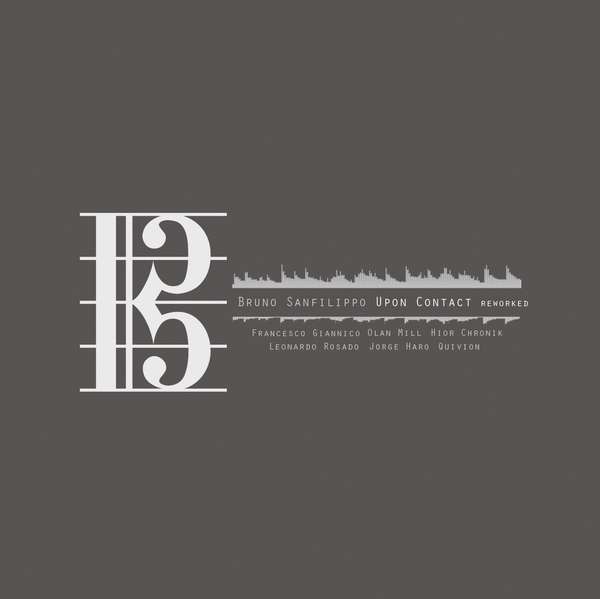
A perfect example of how gorgeous modern classical can be is the music of Argentinian composer/musician Bruno Sanfilippo. Over the past few decades, Sanfilippo has explored the world of minimalist composition in search of new and unique types of music; his 2015 release Inside Life found him exploring the same sort of meditative realms that Brian Eno was exploring in the mid-to-late 1970s. Upon Contact Reworked, released later in 2015, is both more sparse in terms of its sound and more experimental in its concept, featuring a delicate original composition that’s subsequently re-imagined by six figures from the world of ambient electronic music.
The rather somber “Upon Contact” plays a bit like a spiritual successor to things like Erik Satie’s “Gymnopedies No. 1” or Claude Debussy’s “Arabesque 1” since it evokes a sort of childlike wonder, but is much more ponderous and deliberate, with significantly less focus on melody. Sanfilippo’s original composition has almost agonizing stretches of silence which virtually force the listener to confront inner thoughts being inspired by the music, and the whole of the composition suggests a feeling of indecision, leaving many of its fragmentary piano themes unresolved. While most of the track utilizes the upper half of the piano’s range, accented lower notes pop up later on, providing just a hint of closure at its winds down. Considering how unimposing this original piece is, it might go without say that the half dozen alternate versions play mainly as demonstrations of how subtle changes can alter the feel and mood of music.
Indistinct voices and slightly hissy “sounds of space” present in Francesco Giannico’s version seem very much at home in the context of Sanfilippo’s original track. Warmer chords are introduced under the main piano themes, establishing a noticeably more comforting vibe, but the lonely, hanging notes stick out as being even more poignant and nearly haunting at times. Reverberating low tones have been added to Olan Mill’s rework, with the droning quality of the piece suggesting that something inevitable is just about to happen. Unsurprisingly, no “a-ha” moment actually occurs, but a listener is still left with an ominous feeling. Bassy tones present in Leonardo Rosado’s version, probably the most quietly dreamy of the mixes, are more reassuring, combined with humming ethereal ambiance and an ever-so-slightly manipulated main theme that has touches of vibrato and echo applied to it.
Mechanical whirr and piercing electronic beeps and buzzes make Jorge Haro’s version arguably the most distinctive track here, while Quivion’s hazy rework makes use of bubbling sound effects and noisy bird calls that actually downplay the original piano parts. Towards the end, Quivion throws in elements of static and a high-pitched howl, perhaps commenting on the way humankind is intruding into the natural world with its mechanized and increasingly robotic civilization. Similar crackling sound effects occasionally burst forth during Hior Chronik’s rework, which closes the album. The “melody” here has been slightly modified to give it a more defined sense of purpose, and the track ends with an airy fade out.
Upon Contact Reworked plays out in such a low-key, slow-burning manner that I’d frankly be shocked if most people would even be aware that an ongoing album was being played while they listened to it. There’s very little for a listener to latch onto, and only extremely observant listeners would be able to point out major (or honestly,any) differences between the various tracks. As such, while I don’t think anyone would or could completely dislike what Sanfilippo and his collaborators have accomplished since the album is very pleasant to listen to, this is more something that would suit the taste of open-minded listeners and those who appreciate experimental work rather than the crowd accustomed to popular music. Ultimately, Upon Contact Reworked left me deep in thought – I think one could argue that at least part of the point of this album is to stimulate the imagination of anyone who listens to it - and though it’s not necessarily bright or cheerful, I got a sense from this very peaceful and calming music that all was right with the world. In today’s day and age, almost any music that can inspire such a response is worthwhile in my book.
Related features

Bruno Sanfilippo
One Question Interviews • October 26, 2015
Related news