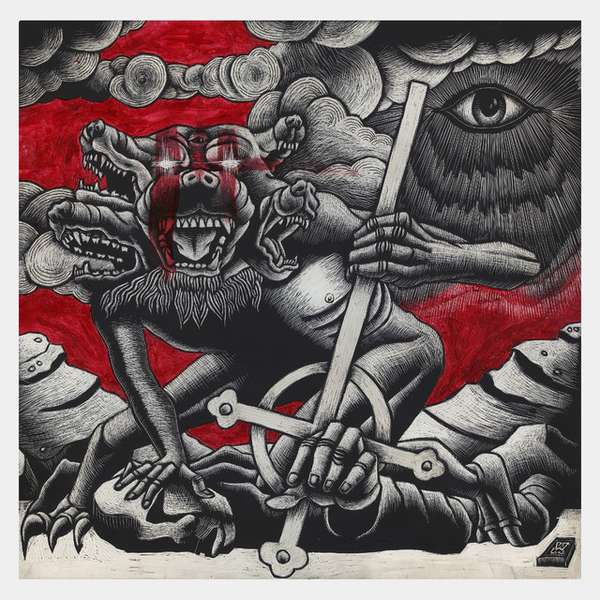
Some records make their intentions obvious from the very beginning. They use the same structure that countless bands have for decades: verse, chorus, breakdown, payoff, and the blunt force of explaining what you are supposed to feel. Hymns for the Denial of God does something much more complex. It’s a series of difficult questions no one wants to answer, proposed by a group of people who feel as if they are tearing themselves apart while asking.
From the opening moments, the biggest strength is the dynamics. Dreamwell creates enormous tension without relying on the usual modern-metalcore signposts. The guitars are ridiculously crunchy, the low end is heavy, and a genuine sense of menace runs through the record. Then, just when everything feels like it is closing in, a hook opens up with this early-2000s post-hardcore quality that feels less like relief and more like yearning.
That yearning is important. The record does not move from tension to hope. It moves from tension to a different kind of pain: a calling out, a need for something to change, paired with the growing realization that nothing may actually change at all. The music and vocals often speak a slightly different emotional language than the lyrics, but they are still saying the same thing. One can express despair directly while the other turns it into panic, grief, accusation, or longing. That layered emotional language is what makes the album feel so alive.
Instability also runs through nearly every track. Everything feels stretched to its most extreme point. The trick is that Dreamwell almost always ends the song just before it reaches that point. It feels like fabric being torn to its limit without actually coming apart. That is where the record's sass and mathcore influence becomes especially effective. There are flashes of The Blood Brothers, The Number Twelve Looks Like You, Dillinger Escape Plan, and that broader lineage of post-hardcore weirdness where theatricality and chaos are part of the vocabulary. Sometimes it is over the top. It is supposed to be. Those moments add instability, but they also add a strange sense of levity. The songs are so intense that the sassier turns can feel like a welcome break, even while the structure underneath them still feels like it could collapse at any second.
The important distinction is that none of those stylistic flourishes feel forced. Dreamwell can bend the album's emotional language and speak in a different dialect without ever abandoning the conversation. The alt-rock textures, the screamo rawness, the mathier aggression, the post-hardcore hooks, the metallic crunch, and the sass all feel like different ways of explaining different parts of the same story.
“Anti-Christ's Testimony” may be the clearest example of the record's entire approach. It begins with a heavy, almost '90s alt-rock quality before dropping into a nasty, mathy metallic-hardcore rage. The song never stays still. It shifts constantly, but the emotional thread never gets lost. The screamed vocals feel pained and accusatory, almost as if the vocalist is pointing a finger directly at the listener. The song doesn't strike me as anti-religious so much as an interrogation of hypocrisy. It asks pointed questions about the gap between professed belief and actual behavior. By the end, the track drops into an ugly, blunt-force breakdown that feels less like payoff and more like structural failure. The song has stretched itself as far as it can go. It cannot function anymore, so it collapses. That idea, collapse instead of resolution, appears again and again.
“A Crisis of Realization,” however, is still the song that affects me most personally. There is something almost Thursday-like in its emotional sweep, with the desperation and aching dynamics of Pianos Become the Teeth and, even more specifically, State Faults. It carries that same quality where beauty and emotional ruin happen at the same time. Reading the song through the lens of mortality and loss makes it hit even harder. It does not just make me think about my own death. It makes me think about the people I have lost, where they may be, whether there is anything after this, and what it means if there is not. That is the kind of emotional response I am always looking for in music. The song is not manufacturing catharsis. It simply opens a door and lets your own grief walk through it.
That may be the best way to describe the entire album's emotional construction. Dreamwell does not design moments to make the listener feel something. It tells an emotional story honestly enough that the feeling happens on its own. The sequencing is a huge part of why that works. The record has a definite emotional arc, and it feels meticulously crafted without feeling overdesigned. Individual tracks can absolutely stand on their own, but they become more powerful in context because each one adds a new layer of pressure without giving the listener complete resolution.
“Apostates & Gentiles” is especially important in that regard. It functions as a break, but not a release. An audio sample plays over a pulsing rhythm while a clean guitar lead keeps gradually increasing the pace. The vocals and full-band violence step aside, but the tension never actually leaves. The song gives the listener oxygen while quietly rebuilding the pressure.
Then the second half escalates. The structures grow more jagged, the post-hardcore weirdness becomes more pronounced, and the record leans even harder into instability. Yet it never becomes random. There is always cohesion. Even when a song evokes something like The Number Twelve Looks Like You before suddenly throwing in sassier flourishes, it still flows because the chaos is compositional, not decorative. That is one of the album's greatest strengths: Dreamwell can make chaos feel intentional.
“I Dreamt I Survived an Extinction Event” is another standout, but for a completely different reason. It may be the most fun song on the record, if “fun” is even the right word here. It begins with an almost Weezer-like post-hardcore quality before taking off into Dillinger-meets-Blood-Brothers territory. It proves the band's creativity can translate into something lighter and more playful without losing the anxiety or instability that defines the rest of the album.
The vocals are crucial to all of this. The raw screamo-inspired delivery carries the anxiety rather than simply sitting on top of it. The voice sounds strained in the right way: not technically deficient, but emotionally frayed. It belongs inside these songs.
The production deserves just as much credit. The guitars and drums are allowed to breathe. The guitars occasionally have this Dillinger-meets-Every Time I Die tone, the low end is heavy without swallowing the mix, and every cymbal hit has room to register. Empty space is actually used. When one element drops out, another can step forward without everything competing for attention. That means heaviness can come from subtraction as much as addition.
And then there is “Cherub Rock of Gibraltar.” By the time the closer arrives, the record has spent its entire runtime building emotional pressure without offering true completion. Every song adds something. Every collapse leads to another question. Every accusation creates another layer of tension. The closer finally feels like the end. Not a happy ending. Not resolution in the traditional sense. It feels like a last gasp. The emotional center of the record may actually be here rather than in “A Crisis of Realization.” That track may affect me more personally, but “Cherub Rock of Gibraltar” feels like where the album's entire argument finally lands. We have spent the record pointing fingers outward, at hypocrisy, cruelty, self-righteousness, belief, indifference, and by the end some of those fingers start turning back toward ourselves. We are tired of screaming.
So what now? What do we do after all of the accusations? How do we fix any of this? How do we correct course? What happens when recognizing the problem is no longer enough?
The record ends not with optimism, but with something more interesting: hope buried inside hopelessness. Defiance in the face of self-righteous indignation. The final line, “Don't waste your Heaven on me,” does not feel like surrender. It feels like refusal, a rejection of becoming someone else's excuse for martyrdom.
That is why the ending works so well. Dreamwell does not pretend the problems are solved. The record simply reaches the point where screaming about them is no longer enough.
Hymns for the Denial of God is harsh, beautiful noise: skramz-y post-hardcore with metallic crunch, sass instability, and a deeply human emotional core. It is a perfectly paced, stylistically adventurous, over-the-top release. More importantly, it understands that emotion is not something you manufacture with a perfectly timed breakdown or oversized chorus. It emerges when every part of the song speaks honestly.