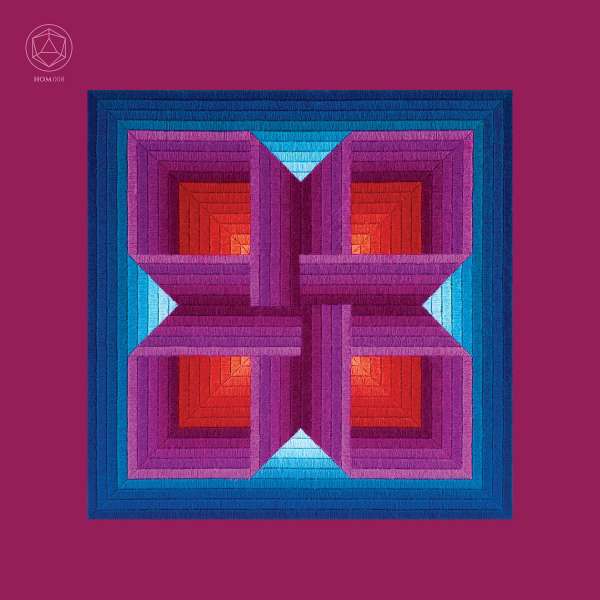
Another excellent release coming through the House of Mythology label, Teleplasmite is the brainchild of an unholy alliance between Mark O. Pillington, musician known from his work in Urthona and author publishing interesting countercultural and cryptic literature through Strange Attractor, and Michael J. York, expert in wind instruments and member/collaborator of the Guapo, Cyclobe, The Stargazer's Assistant and of course, the legendary Coil.
The title of the record says it all: “frequency is the new ecstasy.” At the center of any sound lies a combination of frequencies, able to be decomposed into a number of singular sinewaves, providing the path to an ecstatic sensation through aural stimuli. This was a fact known by early minimalist experimenter and synthesis wizards, which ambient pioneers in the likes of Cluster, Tangerine Dream and Brian Eno, would later build their music around. For Teleplasmite, this is an escape to a meditative state, a way to examine reality as an illusion through experimental means, as the process by which the drones and mesmerizing percussion of the opening track craft a transcendental scenery.
Trapped in this otherworldly sensation, the duo find themselves in a trajectory between the physical dimensions and their restriction, in “Gravity is the Enemy,” the mind and its capabilities, in “Mind At Large,” and a manner in which one can escape from one plane of existence to the other, focusing on the ancient Zoroastrian excarnation ritual in “Astodaan,” known as the tower of silence. The properties are addressed with a universal view on mysticism, encompassing what can be perceived as a world music inclusion, moving through oriental melodies, traveling further into the past, to be propelled to the future. The slight jazz twists, very subtle in their presence, reveal a hidden expressive nature, one that does not follow constantly the repetitive ambient forms but diverges from the mean, another element of spirituality used to mold the minimalistic tendencies with the abstract renditions.
Through the waves of “Mind At Large” coming in a hearbeat-like pace, and the metallic quality of “Fall of the Yak Man,” the duo unravels the essence of experimental music, dictating the expressive soundscapes to construct these mind altering states, providing in the process some of the more direct pieces of the record. Still, Frequency Is The New Ecstasy is a tough record to go through, and the information that Teleplasmite is attempting to pass on, are complex in their simplicity. In this deconstruction of sounds, performed to uncover the ecstasy of the frequency, it becomes clear that this is a work to be experienced through multiple listens in order for its subtlety, its abstract quality, the delicacy of the sounds and the grandiose drone scenarios to be understood.