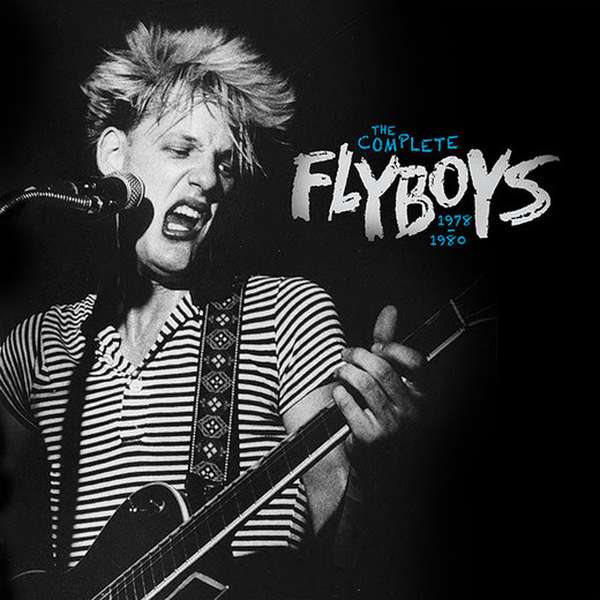
The archival hunt for the "missing links" of first-wave California punk usually leads through a trail of grainy handbill Xeroxes and tape traders' overdubbed copies. But with The Flyboys, the story has always been a bit more elegant—and a lot more colourful. Long before they were swept into the gravity of the Hollywood scene, frontman John Curry was already performing the role of a rock star. Sporting day-glo threads and a bleached-blonde pompadour, Curry was a deliberate artistic construction in a scene of accidentalists, famously encouraged by a circle of friends who treated him like a legend before he even had a band.
With the release of The Complete Flyboys 1978-1980, Frontier Records isn't just reissuing its inaugural catalogue entry; it’s providing a much-needed autopsia cadaverum of a band that effectively became a residual ghost just as the ink was drying on their debut 12”.
The history of their self-titled 1980 EP is a classic "midnight recording" tale. Frontier founder Lisa Fancher, then a rock scribe for the L.A. Herald Examiner, was so struck by the band’s lack of traction despite their powerhouse live sets that she started the label just to get them on delicious vinyl. She famously paid for studio time "under the table" to sneak the band into Leon Russell’s high-end Paradise Studios in North Hollywood. With Jim Mankey (Sparks, Concrete Blonde) engineering and producer Scott Goddard (manager of the Dickies) at the helm, the sessions aimed for a sophisticated power-pop sheen. However, that meticulous "pledge polish" became a momentum-killer; the recording took so long that the band dissolved before the first pressing even had a chance to cool.
That is why the "lost" history excavated from bassist Scott Lasken’s closet is such a revelation. Lasken literally stumbled upon a 45-year-old reel of tape in 2024—a find so obscure even Curry had forgotten the recordings existed. The addition of these five unreleased 1979 demos provides the necessary grit that the Paradise sessions occasionally smoothed over. In these recordings, tracks like "Live for Today" and "Every Day" are stripped of their "studio miss manners," revealing a band that was faster, looser, and far closer to the raw adrenaline Curry recalls from their earliest "official" gig—a five-dollar set for a car club called the Swampers at a Fontana union hall where the whole band ran through a single amp.
The collection finally gives tracks like "Square City" and "Crayon World" their proper due on LP and CD. "Crayon World," in particular, remains one of the era’s most effective critiques of superficiality, delivered with the kind of infectious hook that became the band's trademark.
By the time Fancher released the EP in March 1980, the Flyboys were already a memory. They left behind a "what-if" legacy that has lived mostly in the crates of serious collectors. This 14-track collection, featuring Curry’s own archival design and never-before-seen photos, finally provides the definitive document they deserved. It’s a vivid reminder that while early punk was often about the hot embered burn, the Flyboys were one of the few bands who truly understood the brilliance of the first spark.