When I saw The Dead Milkmen at Toronto’s Diamond Club back in the late 1980s, the floor was a volatile, beautiful mess of colliding subcultures. It was like different species of house flies bumping into one another, wondering what the hell you were doing in the mason jar. You had suburban high school pocket-pen-protector pencil-neck nubile nerds, college radio snobs with their coffee-stained teeth chomping on about the latest obscure release from Tasmania, snot-nosed pop-punk brats who were yet to be named Emo mush puddles, and heavy-booted skinheads in braces and Docs—all squeezed like a freshly poured glass of testosterone alongside a peacocked array of colored hair. And yes, the punk rock girl. All into the same room.
In true Milkmen fashion, I convinced a group of my high school friends that I was about to march straight over and start a brawl with the largest, baldest boneheads in the venue. I dragged them along right up to the impending figures, squared up for a fake punch-up, and watched my terrified buddies scatter like flies on shit when the boot comes down. The joke was on them: I actually knew the guys. In true skin fashion, they grabbed me by the arms and boots and threw me straight onto the stage. Fun times.
My point is that The Dead Milkmen appealed to such a wide array of figures, subsects, and subsections subjected into other subsections that they almost subjected themselves into obscurity.
That chaotic, singalong confusion was the exact spirit of the band. Were they just snot-filled brats with a soft-punk edge, or was there something deeper going on when you scratched under the surface of the crusty nostril looking for that hard green nugget ready to flick across the classroom or possibly eat? (Mucus contains natural salts, after all, and some children report that boogers taste salty or savory.)
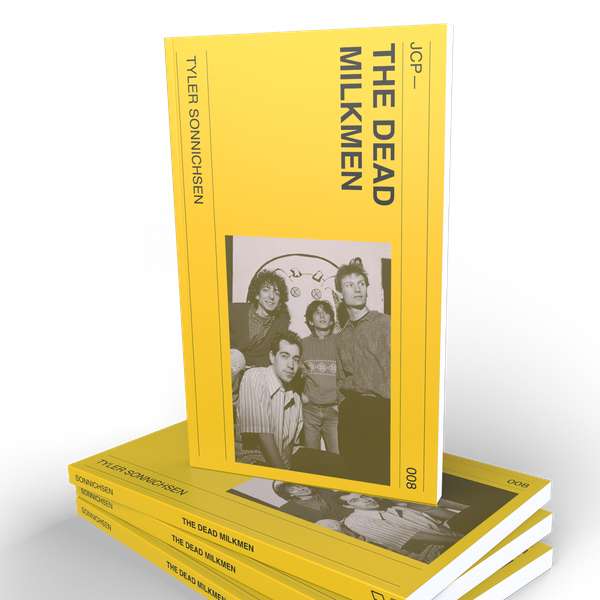
In The Dead Milkmen (J-Card Press), music geographer Tyler Sonnichsen argues persuasively that it was always both. The Milkmen spent decades lying to music journalists, inventing surreal origin myths in fan club newsletters, and writing three-chord songs about bleach, lizard monsters, and tax evasion (look away, Uncle Sam). In return, traditional music criticism did what it always does to bands with a sense of humor: it tossed them into the novelty bin alongside Mojo Nixon, They Might Be Giants, The Meatmen, and Dayglo Abortions, dismissing them as a goofy MTV anomaly. Music critics are apparently devoid of funny bones. It is a proven fact—or, if they do possess them, they largely don't realize they are funny themselves.
Sonnichsen’s ~200-page biography finally gives Philadelphia’s favorite wacky weirdos the serious, unpolished document they’ve deserved since 1983. It's like that special bag of popcorn that you carefully cut a hole in and put on your lap, ready for your date to discover the source of the butter. Crucially, Sonnichsen avoids the trap of "straightening them out." As the book demonstrates, the second you try to sanitize or standardize the Milkmen, they cease to be the Milkmen. (Fact: my father remembers, as a small child, the Watermelon Man whom he insipidly was afraid of. Future horror writers, take note.)
Rather than delivering a dry, linear aural history, Sonnichsen builds the book like a curated, all-you-can-eat buffet of standalone essay-chapters named after key tracks. In one standout section, he deconstructs "Bitchin' Camaro" through five distinct "crashes" that make the song tick, untangling how suburban kids messing around on cheap gear created a permanent piece of American satire. He strips away the band's self-fabricated lore, but clearing the brush only highlights their deliberate genius. They could have been rocket scientists!
Sonnichsen’s background as a geographer pays massive dividends. He maps out the gritty DNA of 1980s Philadelphia underground spaces, treating the local venue ecosystem not as a backdrop, but as a central character. The book captures the sweat, revolving cowboy doors, and DIY hustle that shaped Joe Jack Talcum, Rodney Anonymous, Dave Blood, and Dean Clean.
The book's most provocative argument is one that will make hardcore purists squirm: the Dead Milkmen deserve just as much credit for DIY integrity as "don't pay more than $4.99" Fugazi. While 80s hardcore bands shouted about politics wrapped in grim, performative tough-guy posturing (think Charles Atlas in Docs shitting steel bricks), the Milkmen took the opposite route. They were involuntary insiders—deeply embedded in the underground like characters from your favorite breakfast cereal (Trix are for kids and prostitutes), yet utterly unwilling to adopt its rigid, conservative woof-woof dogmas. Rodney’s venomous, highly literate SIN-incal cynicism combined with Joe Jack’s folk-patchouli-punk nonchalance allowed them to hold up a mirror to the very subcultures they belonged to. Mirror, mirror on the wall... Their satire wasn't throwaway comedy; it was a zero-bullshit "field guide to a rotting empire." Watch out for the cow patties.
Sonnichsen handles the heavier second act with genuine care—chronicling their frustration as 90s corporate alternative rock left them behind and embraced Grunge with dirty fingernails and greasy hair, their 1994 breakup, and the tragic 2004 suicide of original bassist Dave Blood. But rather than ending on a dark note, the book frames their reunion—with Dan Stevens stepping in on bass—as a triumph of survival. Today, they remain active elder statesmen of Philly punk, playing local benefits and releasing records entirely on their own terms. (Elder statesmen... Wow. I still think of them as those goofy kids squirting cars with ketchup bottles.)
Sonnichsen avoids forcing a neat, corporate narrative onto a band defined by contradiction and inside jokes—and thank God for that. The result is a biography as chaotic, smart-aleck, and essential as Big Lizard in My Backyard. It restores the Dead Milkmen to their rightful place in punk history: not as a joke band that got lucky on MTV, but as satirists who proved that taking the piss out of authority—and out of punk rock itself—is the most rebellious thing you can do.