Ed Sheeran
Accor Stadium
Sydney, Australia
14 February 2026
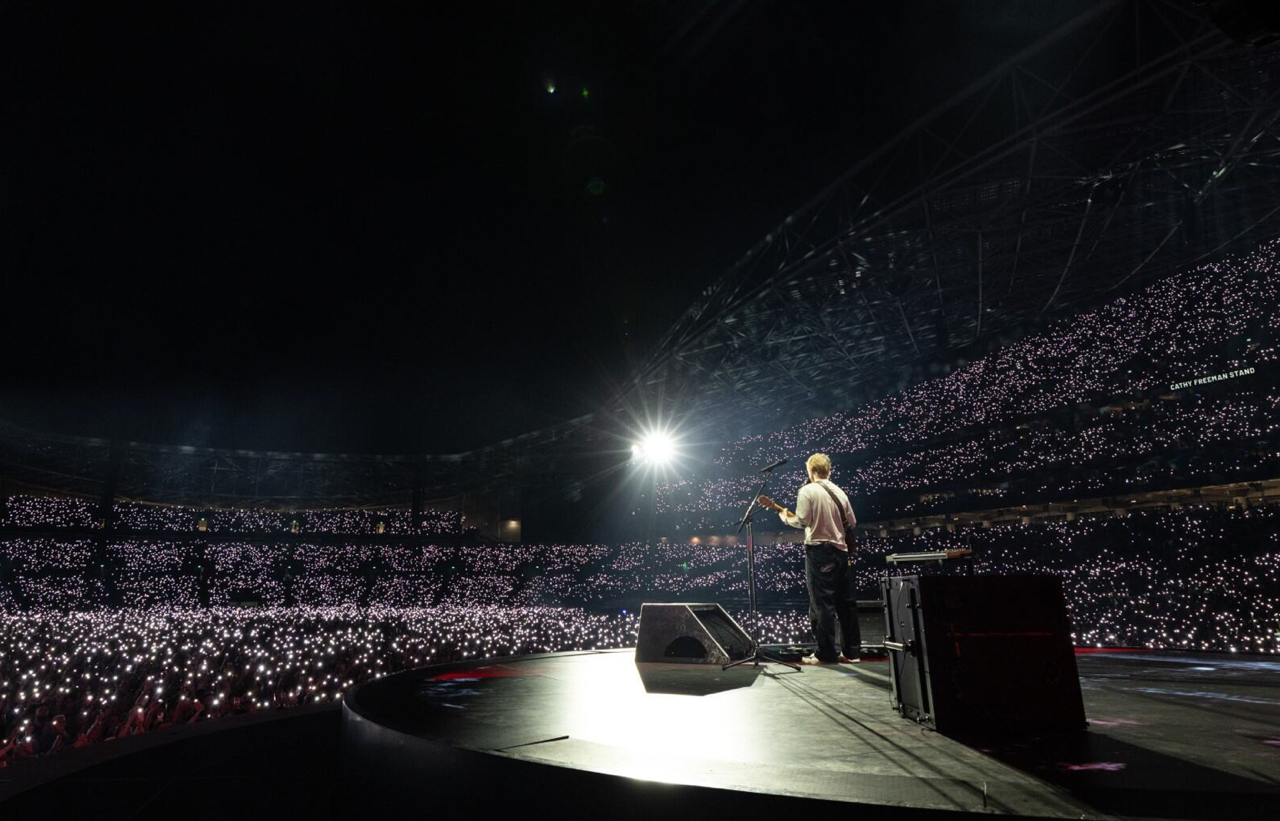
On Valentine’s night, seventy thousand people assembled at Accor Stadium to watch Ed Sheeran test a quiet paradox: whether a space designed for mass spectacle can be persuaded to behave like a private exchange.
The answer, as it turns out, lies less in scale than in structure.
Sheeran’s performance logic is architectural rather than theatrical. Songs do not arrive fully formed; they accumulate. A rhythm tapped into the guitar body becomes foundation. Chords settle over it. Harmonies are introduced with the patience of someone stacking beams rather than chasing applause. Within minutes the solitary figure onstage produces something that reads as collective. Many musicians employ loop systems. Few have reorganised the economics of stadium touring around one.
His entrance refuses grandeur. He appears almost incidentally - a small, copper-haired figure on a circular platform dwarfed by the infrastructure meant to amplify him. The brief uncertainty in the crowd, that fractional pause before recognition, feels intentional. The entire evening rests on that tension: immensity presented as modesty, machinery framed as intimacy.
The production itself is meticulous. Screens fracture and multiply his image. Flame jets punctuate choruses with algorithmic precision. Moving structures slide into place with the assurance of well-funded engineering. One imagines Guy Debord would have recognised the completeness of the spectacle immediately. And yet the spectacle never fully claims the room.
Attention keeps drifting back to the pedals.
There is something quietly persuasive about watching a song assembled in real time. The process does not diminish the effect; it sharpens it. Sheeran’s gift is not virtuosity so much as intelligibility.
He exposes the scaffolding, and in doing so transforms construction into performance. The audience is not merely witnessing songs; it is witnessing the act of making them, which confers a sense of shared authorship, however illusory.
What prevents the sentiment from curdling is his calibration. He understands how much emotional directness a crowd can absorb before it tips into excess. Ballads arrive at precisely judged intervals. Phones rise in synchrony until the audience itself becomes a luminous extension of the stage design. It is sincerity shaped with the care of choreography - not manufactured, exactly, but undeniably managed.
A moment in which the crowd is instructed to trigger their camera flashes during a lyric about presence encapsulates the method. The contradiction is obvious, acknowledged, even gently mocked. Rather than undermining the sentiment, the self-awareness seems to legitimise it. The performance does not deny its own artifice; it incorporates it.
When additional musicians briefly join him mid-set, the sonic density increases but the clarity recedes. The architecture softens. The loop system reveals itself not as embellishment but as spine. Without it, the show becomes merely large; with it, it remains precise.
“I See Fire” provides the evening’s closest brush with myth. Flame columns rise in synchrony with the melody, and for a moment the scale feels earned rather than imposed. The song carries its theatrics because its structure is strong enough to support them - an increasingly rare quality in arena pop.
By the closing stretch, Sheeran registers less as performer than as conduit: a stabilising route through which familiar emotions travel with unusual efficiency. He is not reimagining pop’s emotional vocabulary. He is refining its transmission.
The dispersal afterwards unfolds with the muted choreography of shared experience dissolving into private memory. Children asleep in merchandise hoodies. Couples speaking softly, as if leaving a ceremony. Someone humming a chorus as though it belonged uniquely to them. In a sense, that is the product being offered.
Strip away the pyrotechnics, the screens, the mechanical bridges, and the proposition is almost austere: one guitar, one recursive device, one performer repeating the same emotional exchange until repetition acquires the gravity of ritual.
He has not reinvented busking.
He has simply extended its radius until the gesture fills a stadium.
And the loop, patient and exacting, continues to turn.