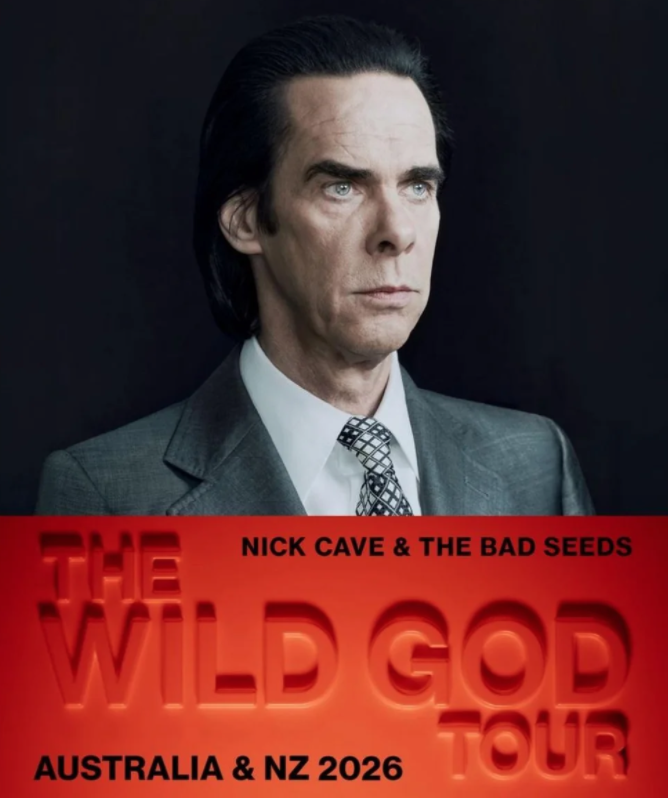
Nick Cave and the Bad Seeds
The Domain
23 January 2026
Sydney, Australia
On a humid January night at Sydney’s Domain, Nick Cave & The Bad Seeds demonstrated something increasingly rare in contemporary touring culture: not merely longevity, but artistic liquidity. Over two and a half hours, the band unfolded a set that refused the logic of retrospection, instead behaving like a living archive - porous, unstable, and responsive. This was not a career survey. It was an argument for continuation.
Outdoor shows often dilute intensity, dispersing attention across grass, sky and distance. Over the past decade, Cave has been quietly recalibrating how closeness functions in rooms designed for thousands. What unfolded at the Domain felt closer to a ritual assembly than a spectacle, driven by direct address, sustained eye contact, and Cave’s instinctive understanding that proximity is psychological before it is physical. His movements - prowling, stooping, clasping hands at the barricade - echoed the physical vocabulary he has refined since the Push the Sky Away era, where vulnerability replaced confrontation as the primary mode of engagement.
Opening with “Frogs” from 2024’s Wild God was both a statement of intent and an act of confidence. The song’s choral ascension, powered by backing vocalists Wendi Rose, Janet Ramus, Miça Townsend and T Jae Cole, immediately positioned the evening within the album’s spiritual register. Wild God is arguably Cave’s most openly devotional work since The Boatman’s Call, though its faith is restless, interrogative, and plural. Live, its songs function less as declarations than as invocations - open-ended, searching, and insistently communal.
That eight tracks from Wild God appeared in the set is significant. For a band entering its fifth decade, this degree of reliance on new material signals more than relevance; it suggests trust. Cave has often spoken about the audience as collaborators rather than consumers, and the Domain performance bore this out. Songs such as “Song of the Lake” and “Cinnamon Horses” were received not as interruptions to the canon, but as necessary extensions of it. The effect was cumulative: Wild God did not sit alongside the catalogue so much as reframe it.
This reframing was especially apparent when older material surfaced. Early works like “From Her to Eternity” and “Tupelo” retained their feral intensity, but their context has shifted. Once expressions of gothic extremity, they now read as foundational myths - origin stories that still pulse, but with the distance of time lending them clarity rather than menace. “Tupelo”, in particular, emerged as operatic tribal blues, its apocalyptic imagery amplified by the open sky, as if calling upward rather than inward.
Cave’s performance style continues to oscillate between preacher, provocateur and self-satirist. His offhand humour functions as a pressure valve, puncturing solemnity without diminishing emotional stakes. This self-awareness is crucial. Cave understands that sincerity, left unchecked, curdles into dogma.
“O Children” itself became one of the evening’s emotional fulcrums, with Warren Ellis emerging from his seat to deliver a violin solo that felt less like embellishment than communion. Ellis remains the band’s alchemical agent, bridging Cave’s increasingly expansive creative universe with the Bad Seeds’ core identity. His presence also underscored the porous boundaries between projects, particularly with the inclusion of “White Elephant” and “Carnage” from the Cave–Ellis collaboration Carnage. These songs did not feel imported; they felt inevitable.
Musically, the Bad Seeds continue to operate as a finely calibrated organism. George Vjestica’s guitar work was precise yet unrestrained, carving through the controlled chaos of “Jubilee Street” and “From Her to Eternity”. Carly Paradis’ keyboards provided a textural counterbalance, while Larry Mullins and Jim Sclavunos delivered percussive patterns that felt both martial and elastic. Colin Greenwood, still deputising for Martyn P. Casey, brought a measured authority to the low end, anchoring the band without drawing focus.
Visually, the production resisted excess. The band appeared in stark black, white and sepia on the giant screens, reinforcing the sense of collective labour rather than individual dominance. This aesthetic restraint mirrored the music’s emotional architecture: even at its most explosive, the show never tipped into bombast.
Later-era songs such as “Bright Horses”, “Skeleton Tree” and “Long Dark Night” carried a different weight entirely. These works, shaped by grief and its aftermath, have gradually shed their initial fragility to become something more resilient. Live, they function as quiet acts of defiance - proof that reflection can coexist with momentum. The crowd’s attentiveness during these moments was striking, the silence as active as the applause.
The encores unfolded with a generosity that felt unforced. “Wide Lovely Eyes”, played for the first time in 13 years and noted as a favourite of Cave’s wife Suzie Bick, was tender without sentimentality. “Papa Won’t Leave You, Henry” reintroduced swagger and threat, while “The Weeping Song” reaffirmed the band’s enduring fascination with biblical cadence and moral ambiguity. Cave’s final, solitary turn at the piano for “Into My Arms” stripped everything back to essence. No irony, no adornment - just a song that has outlived its moment to become something closer to a secular hymn.
Earlier in the evening, Aldous Harding’s support set - austere, idiosyncratic, and quietly confrontational - established a tonal throughline rather than a contrast. Her presence also gestured toward the trans-Tasman cultural currents that have long sustained the Bad Seeds’ audience, a lineage that will continue with the band’s forthcoming Wellington performances as part of the Aotearoa New Zealand Festival of the Arts 2026.
Nick Cave & The Bad Seeds have spent over forty years resisting the embalming tendencies of legacy. What emerged most starkly at the Sydney Domain was an ethical insistence - that performance is only justified while the work remains animate. As Cave drifted offstage and into the night, leaving the piano behind, the feeling was not one of closure, but of celebration.