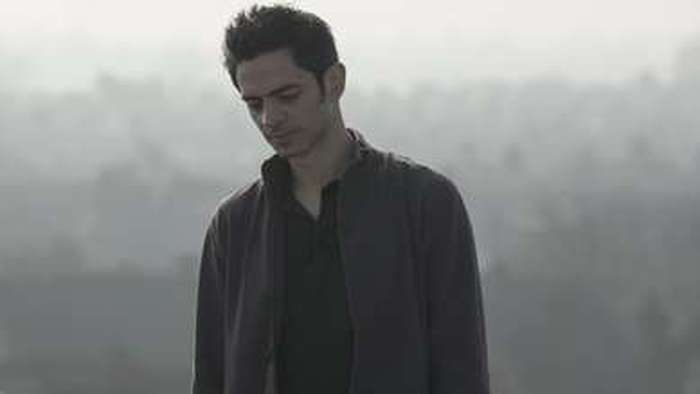
The closing track on electronic musician Hiatus' latest album All the Troubled Hearts immediately catches you off guard. The gravelly voice of an older gentleman speaking Farsi, and then translating the Persian poetry he is reciting into English, is the centrepiece of “Delam”, which contains the simple attribution of "(feat. Dad)".
It's an unusual turn for an album laced with delicate electronic waltzes and swirling vocals that rise and collapse into twinkling piano codas and subtle instrumentation. The first time I heard "Delam", it played on my mind for hours. The track features the line, "Life is like a tangled ball of wool, where the beginning starts with nothing and ends with nothing", delivered with a wavering but determined voice. It threw me off my axis for a while after I first heard it, like all good poetry should.
Cyrus Shahrad, who has made music under the moniker of Hiatus since 2009, collaborated with Shura on his 2013 album Parklands, and for All the Troubled Hearts he collaborated with songstress Charlene Soraia and folk musician Daudi Matsiko. The album winds its way through cinematic soundscapes, which is reflected in the video for “Father”. The video was filmed in a Lebanese village featuring local villagers, who you could easily mistake for being trained actors.
But beyond the cinematic soundscapes there is a persistent longing in Cyrus's work, which seems to get increasingly dogged with each album. The London-based musician, whose mother is British and father is Iranian, is trying to etch his father's memories and experiences of growing up in pre-revolution era Iran into his musical output, while also using it as a vehicle to explore his own Iranian heritage.

Scene Point Blank: You collaborated with Daudi Matsuko and Charlene Soraia on All the Troubled Hearts. How did that come about?
Cyrus: I was introduced to Daudi by a friend who works at a record label and was like, “I met this guy, I think you’ll really like him”. People do that sometimes, they’ll just say, “I've heard this person's music and you should work with so-and-so”. I heard Daudi’s voice and I thought it was fantastic. We got together a couple of times, and as always with these things it's kind of trial and error. We went through a few different tracks. He tried singing other songs that are on the album that didn't quite work, and then that one actually I wrote for him, “All the Troubled Hearts”. I just wrote that song for him to sing.
I’ve known Charlene for years and years and years. I used to play in a band, and when we were going around London doing gigs she’d crop up at them. She'd just sit on a stool with a guitar and sing, and her voice was so mesmerising. I was so blown away by her energy and her voice. For years, I’ve been very keen to work with her. And this was just the first time that we managed to get around to doing it. I really love “Celestial”. I’m really happy with how it turned out.
Scene Point Blank: Are there any plans for you to play live?
Cyrus: There are a lot of people, I think, who would like me to play live but at the moment it’s not really a huge priority for me. I’ve thought about it many times, different ways of playing live. Fundamentally, I don’t want to end up being a knob-twiddling electronic performer — it sometimes feels a bit pointless. I’ve played in bands all my life, and I love playing live, but I don’t like the idea of standing on stage with a bunch of electronic equipment and making noises. If I could do stuff with more people, like get some live strings involved or get a double bassist, then it would be great — I’d love to do that. But it’s just so time-consuming and, ultimately, what I’ve come to accept is that I am first and foremost a composer, and not a performer. My interest is in writing music rather than playing it live. I also think I’m missing a trick, possibly. Maybe it could be a really big thing in my life if I were to take that stuff out and play it. I just think it would be complicated to begin with.
Scene Point Blank: Is it true that all of the people in the video for “Father” are locals from a Lebanese village?
Cyrus: The video’s director, Karim Kassem, lives in New York but his family are from Beirut. And that little village, I think, is just outside Beirut in the mountains. He went with his father to that village, and his dad knows people there. He chatted to them and was like, “My son’s making this film. Would you guys be willing to be actors in it?” And they were all just people that lived in the village that he roped into doing it.
Scene Point Blank: From watching the video, you’d think they were professional actors.
Cyrus: Karim actually buried one of them in the snow for one of the scenes and the guy was like, “Yeah, that’s fine”. The same bloke was hanging from a crane by a belt. So that scene where his father is suspended in the air in a vision, basically they hung him from a crane loaded to the back of a truck, by his belt, and then they just Photoshop out the rope that he was hanging by. None of them were actors, and none of them were paid for it. They were just like, “Yeah, we’d love to do the film”.

Scene Point Blank: Your videos are always interesting. I'm thinking of the video for “Precious Little”, where you covertly recorded your father when he was walking around Iran.
Cyrus: That video is so poignant and so important to me. I spent so much time in Iran walking behind my dad, he just leads the way — he wants to wander around his old neighbourhoods and the places he grew up in. I just followed him around, and then after a while I got so used to seeing the back of his head while I was walking around in Iran that I thought I might just film him. And after a while I thought, I’ve got so much of this footage of him walking around, why don’t I just stick it together and make a video? And it seemed fitting for that song as well, just something really thoughtful. It’s about memory, and growing up and growing old, and it seemed to fit.
Scene Point Blank: Has your father seen the video?
Cyrus: He's funny with stuff like that. Yes, he has seen it, I’ve definitely shown it to him, but he’s not someone who gets excited about stuff like that. I found out yesterday that when you Google the words “Iranian poetry”, the fifth result that comes up is an article I wrote for The Guardian about a track that I did with my dad called “Delam”. So I called home and I said, “Mum, you’ve got to tell Dad, this is crazy.” But my dad just doesn’t give a shit. He just doesn't care. He doesn't understand the implications of the fact that people have seen or read or heard this stuff that he’s involved in. He just doesn’t get it.
Scene Point Blank: So when he saw the video was he indifferent to it?
Cyrus: I don’t remember what his reaction to the video was, but doing the track with him was the thing that I was really conscious of. The last track on All the Troubled Hearts, called “Delam”, is him reading this old, Iranian poetry. Doing that track, and putting it together, was so important to me. But, again, I play it back to him and he’s just like, “Hmph, I don’t sound all that strong”. Either he doesn’t care, or he doesn’t understand, that this means that people are actually interested in him and his life. I think part of my desire to make music is just about trying to get people to know about who my dad is. I don’t know why, but I’ve got this urge to try and make him famous in some small way, but I’ve realised that he’s never going to care.

Scene Point Blank: In your piece in The Guardian you mentioned how your father really didn’t like how he sounded on “Delam”. Has he been able to listen to the track in its entirety, and if he did, what did he think of it? Has his opinion changed?
Cyrus: I don't think he would ever listen to it. My dad’s quite a complicated person, and he’s a typical Iranian man. Emotionally, he’s quite boxed up. He's not someone that lets his emotions out easily, I’m quite similar in some respects but when it comes to music I’m completely open, emotionally. I write music that’s very emotionally open and expresses what I think are great gulfs of vulnerability. I don’t think my dad is 100 per cent comfortable with that, from his point of view. It's not that he has a problem with me doing it, but he's not someone who would listen to that track and be like, “Oh, it's wonderful, it’s a real expression of the human condition”. He’s not really that sort of person.
"It sounds kind of sad, but Iranian men generally do not tell their kids that they love them, and their kids don't generally tell their parents that they love them. Through doing this music I've been able to express that in a way that I couldn't, verbally, with my dad."
Scene Point Blank: When I was looking at your videos I realised that the video for “Save Yourself” is dedicated to your father, then you described the video for “Iran Air” as being a tribute to him, then of course there’s the recordings of him in the video for “Precious Little”. What impact does your music have on your relationship with your father?
Cyrus: It’s changed my relationship with him, definitely. One of the things that Iranians don't really do is tell each other that they love each other. It sounds kind of sad, but Iranian men generally do not tell their kids that they love them, and their kids don't generally tell their parents that they love them. It's not something that male culture really allows for in Iran. And I think that through doing this music I've been able to express that in a way that I couldn't, verbally, with my dad. I might not be able to say that [I love him], but I can make songs that hopefully convey that, and how he responds to that is beyond my control. But it makes me feel better to know that I’ve at least given it a go.
Scene Point Blank: It’s almost like you’re cementing memories by committing them to tape.
Cyrus: It’s like he’s a relic of a part of Iranian history which is increasingly dying, like pre-revolutionary Iran. When he was growing up there were casinos, people went gambling at night and to discos, there were girls in miniskirts and things like that. That part of modern Iranian history is soon going to be forgotten, and my dad’s a time capsule of it, in some respects. I always find it fascinating when I go to Iran now, the Iran that you see now is very, very different to that. And yet there are still people like my dad who walk around carrying the memory of it. So, unlocking that is part of my musical mission as well, in some ways.