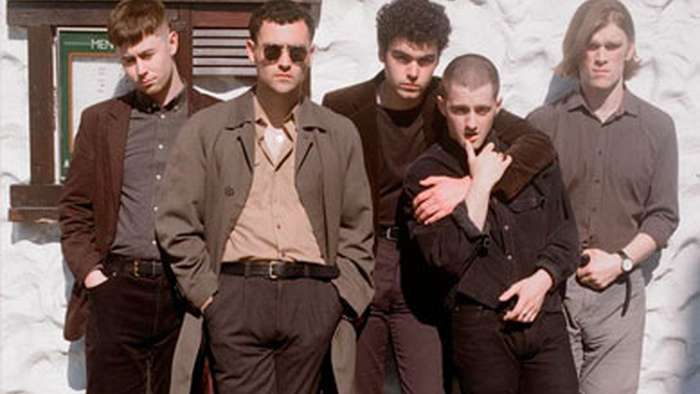
When Irish five-piece The Murder Capital recently released their debut album When I Have Fears, it was rapturously received by critics and music fans alike, with the band’s post-punk sound viscerally tapping into grief and disillusionment across the album’s ten tracks. The record was inspired by the suicide of a close friend of frontman James McGovern, and its title is aptly taken from a sonnet by the 18th Century Romantic poet John Keats, that centres on a fear of mortality, and not achieving all of the things you want to before your demise.
The Murder Capital started attracting attention with a live recording of their seething, bruising song “More Is Less" in May 2018. At this point, as interest in the band was building, instead of releasing a glut of singles, fans had to wait several months for new material. The delay in new material was looked on cynically by some as a marketing strategy, but as guitarist Cathal Roper explains, that wasn’t the case.
“Some people fantasise about it, like it was this strategic plan and it all worked out,” he says. “We dropped “More Is Less”, and then, a month later, word got over from the UK that a couple of people were putting on a showcase for this group of live agents.
“We spent the whole summer setting up a team and then, when we had the people we liked around us, we started strategising the year then -- but even then, it was very, very loose. We just got new members and everything. We were like, ‘Where are we gonna go with this?’ Everything was moving fast, but it didn’t feel too rushed.”
Shortly after this point, when two original band members had left, the band started to gel with the addition of two new members, bassist Gabriel Paschal Blake and drummer Diarmuid Brennan. All five of the band members went to college at the British and Irish Modern Music Institute in Dublin, with Roper and Blake being in the same year, McGovern and guitarist Damien Tuit were in the year below, while Brennan had already graduated from the college and had been living in New York by the time he met the other band members. Brennan, on his return from the US, was recommended to the band by Tom Coll, the drummer for fellow post-punk Dubliners Fontaines DC.
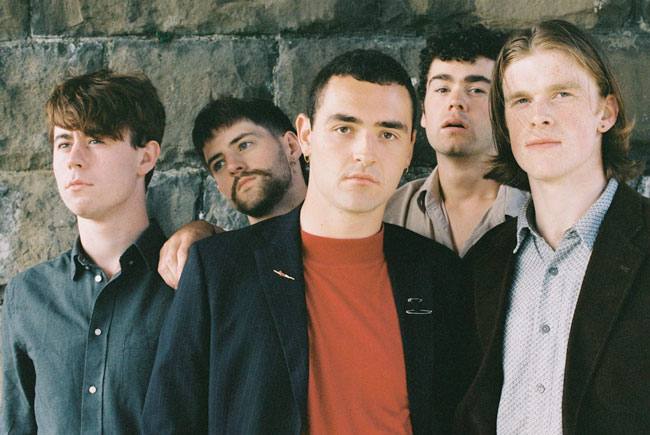
Photo: Gavin Ovoca
“When we had lost the two members, there was a lot of, ‘How do we just bring someone into this?’,” says Roper. “Because the three of us knew what we were like in a room, and we’re straight to the point -- like ‘that doesn’t work’, ‘this doesn’t work’. At times, when you’re working with artists, there can be feelings hurt in the conversation, but it’s not a personal thing. If you really like [something in a song], argue for it or fight for it, and there can be a lot of tension in that. We needed to find someone who could work in that environment.
“It can be tense and there can be shouting and stuff, but it feels really good. The relief of getting the part and getting the song done is so good, and it worked with the guys. I’ve been in bands where it’s like, ‘Oh, he got the part he wanted and this guy’s got the part he wanted’, but the song itself suffers. You can be in your head and be happy with what you’re playing, but the song itself isn’t actually developing right. When the band’s on-point, when everyone’s really in the zone, it’s just great.”
The most fought-over track on the album was the atmospheric “On Twisted Ground”. Drenched in melancholy that you can easily find comfort in, the track’s lyrics are the most direct on the album. As McGovern pleads: “Oh, my dearest friend/How it came to this/With your searing end/Into the abyss”, a gentle guitar backing builds a sense of foreboding.
“If you’d seen our shows before March, you would’ve seen a completely different version of “On Twisted Ground”,” explains Roper. “It was more post-rock. It still has post-rock elements, but it was so close it felt a little bit like stealing -- like, 'This has been done, we’re just another one of those bands if we do it like this.'
“It took us a good two weeks of playing around with different structures, different ideas, and completely different styles [to develop the song]. I was getting really frustrated with it, and there was one point where everybody in the room was playing completely different things. I was really confused. You’d hear a blues thing going on or, like, jazz drumming. Everyone had really good ideas, but it wasn’t as a band.”
"There was one point where everybody in the room was playing completely different things. I was really confused. Everyone had really good ideas, but it wasn’t as a band.”
The key to the development of the recorded iteration of “On Twisted Ground” was stripping the song back to the basics of McGovern’s vocals and Blake’s bass playing, and then building the track from there. That track, along with the rest of the album, was live recorded with celebrated producer Flood at the helm. The album toys with post-punk fused with an industrial sound, which has led to the band receiving comparisons to Joy Division, but it's clear that the band's sound is their own.
When I Have Fears has been an unmitigated success that’s resonated with a lot of listeners. It was critically acclaimed by publications including the Guardian and NME, and soared up the Irish charts to number two, having been kept off the top spot by Ed Sheeran’s No.6 Collaborations Project, on the album’s release week in August.
“We were talking about it in the band, that we were up against Ed Sheeran, and then someone in Hot Press or something wrote an article about it, and that was pretty funny. I think Ed announced a week later that he was taking 18 months off, and my dad called me up and was like, ‘He couldn’t have done that a few weeks sooner, no?’,” laughs Roper.
With the release of When I Have Fears, the band cemented their spot in Dublin’s burgeoning post-punk scene, which has produced Girl Band and the aforementioned Fontaines DC, and they're currently in the middle of a UK and European tour in support of the record. While the Murder Capital is in the midst of a wave of success that most bands can only dream of experiencing with their debut release, Roper says he rarely gets the chance to reflect on it.
“When things start happening for you, it tends to look a certain way to other people,” he says. “For years, it’s kind of happening at you and you’re just saying yes and no. It’s like it’s actually just begun, and you’re just doing it, and then when you have a few days off it’s like, ‘I can actually think about it now, isn’t it fucking mental?’”