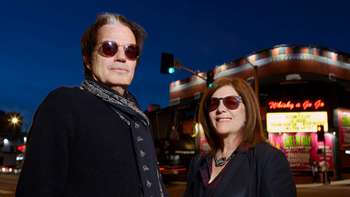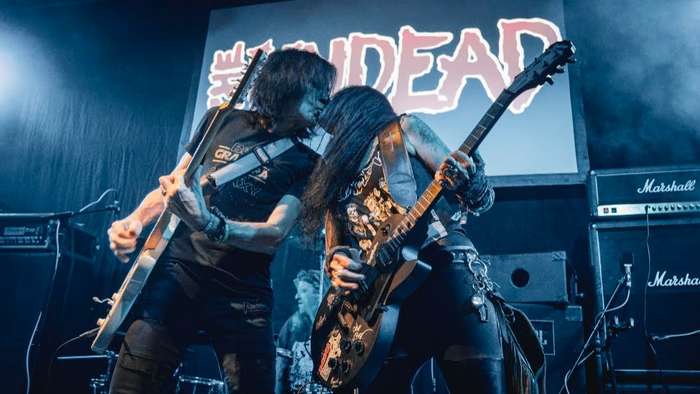
From shaping the early guitar drive of The Misfits to heading up The Undead, slinging bass for Times Square, and running Post Mortem Records out of a New Jersey bedroom, Bobby Steele’s footprint on tri-state punk is as real as it gets. He’s dodged precinct venue shutdowns, survived botched UK tours, and even stripped his sound down to a solo acoustic LP of classic '50s crooner covers. Through four decades of changing scenes, Bobby’s whole career has been built on playing by his own rules.
Part I: Static Age & The Misfits Era
Scene Point Blank: When you put that advertisement in The Aquarian Weekly back in November 1978 looking for a punk outfit with management and a label backing them, how surprised were you when Glenn Danzig was the one who actually responded to your ad?
Bobby Steele: I'd heard of The Misfits when my earlier punk band played the Lodi Boys Club, and I met Steve Zing for the first time. Then, when we played Eddie's Lounge, I saw "Cough/Cool" on the jukebox and played it. I thought it was awful. So when I went to audition. I only really went because I thought it was good to get used to auditioning. I wasn't interested in them at all. Then, they played the Bullet EP -- and I was blown away by the sound.
Scene Point Blank: Your first gig with that original lineup happened a mere few weeks after you joined, right on the heels of the infamous Jonestown killings in November '78. Whose idea was it to dump grape Kool-Aid on the crowd -- did that immediate timing feel genuinely dangerous to you, or was it just seen as ultimate shock-value theatre?
Bobby Steele: That's hard to recall. I just remember that the headline act, Trixie Sly, cancelled last minute and we were asked to go on later. Glenn was the mastermind behind the Kool-Aid idea, and I don't think any of us gave it much of a thought at the time.
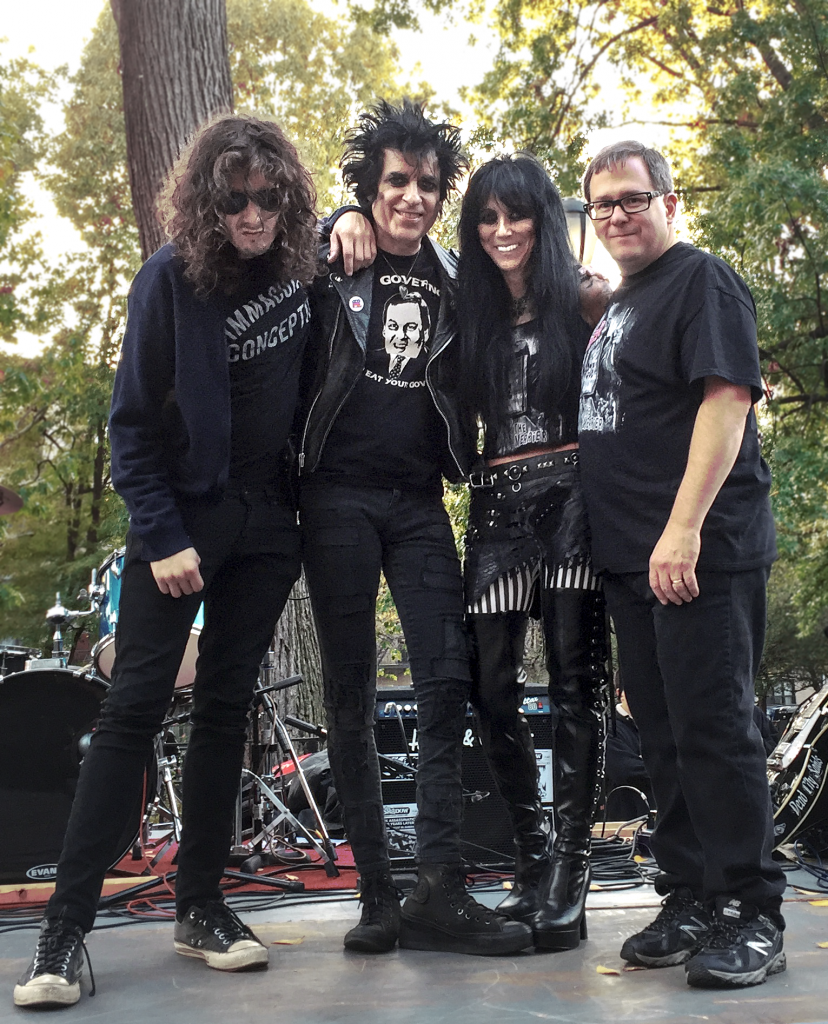
Scene Point Blank: For the Horror Business studio sessions, you were running a Gibson Explorer. How did you keep that specific rig biting and sharp without letting it turn into a piercing, ice-pick-to-the-forehead mess when you cranked the volume?
Bobby Steele: Actually, for Horror Business, I was just running through a 15-watt Music Man amp that was at the studio. I may have been playing my Gibson Explorer. That was the joke as to why I got in the band in the first place. If you see the Bullet tour poster, Franché was playing an Explorer, and I showed up at the audition with mine. As for the Marshall, I eventually had work done on it because it would squeal. I think it was a bad capacitor. It had a "master volume" knob on the back that was poorly rigged, and I eventually had a friend make a true master volume that also improved the sound.
Scene Point Blank: There are old studio stories about Jerry Only running his bass so incredibly loud that his low-end distortion was constantly bleeding directly into your guitar and drum mics. When you were trying to track a clean, driving rhythm line on songs like "Night of the Living Dead," how did you push through that wall of sound?
Bobby Steele: That was just for the Horror Business session. I think my guitar track had more of Jerry's bass in it than it had of my guitar. Joey was in a separate drum booth, so there was no bleed there. For "Night of the Living Dead," we were in a smaller studio, but the bass and guitar were recorded much better, and we had that separation.
Scene Point Blank: When Joey Image quit the band mid-tour in England in late '79, the whole rhythm section completely fractured, leaving you guys totally stranded. How much of the internal tension that eventually led to your own departure a year later was born right there in the fallout of that botched UK trip?
Bobby Steele: I was catching hints that Jerry wanted to get his brother in. I figure he wanted to get Doyle in so that he could take over the band from Glenn. It worked out fine as far as I'm concerned.
I think my guitar track had more of Jerry's bass in it than it had of my guitar.
Scene Point Blank: A massive chunk of your multi-generational fanbase actually discovered your music because your former bandmates sang "Bobby Steele's a Fuckin Asshole" on the live version of "Teenagers From Mars." What's it like knowing that their public spite and backbiting accidentally handed you a lifelong, global audience that is still buying your records 40 years later?
Bobby Steele: I think it was Gene Simmons who said, "No press is bad press," or something to that effect. When I saw the actual reaction to that, I made sure to milk it to the fullest. Because of them, "Act Your Rage" became a hit on college radio and sold out all 7,000 copies on the first day it was released.
Part II: The Birth of The Undead
Scene Point Blank: When you look at how the early tri-state scene gets mythologized on internet forums now, everything is neatly filed into boxes like "horror punk" or "NYHC." Since you were actually on the ground playing bills with everyone from traditional garage bands to the first wave of Sunday matinee hardcore kids -- all while the local councils and police were actively trying to shut down gigs and squeeze out independent venues -- did those stylistic boundaries feel as rigid then as modern historians pretend they were, or was everyone just trying to survive?
Bobby Steele: No. Back then, punk was very diverse -- from pop such as Blondie to psychedelic to artsy. It wasn't until around '81 when the punk rock "thought police" came along and started to dictate what punk had to be that things started to crumble. I mean, I had people telling me that Patti Smith, The Ramones, and the Sex Pistols "aren't really punk."
Scene Point Blank: Your rhythm playing has always had this distinct, rock 'n' roll bounce to it that sounds closer to '50s surf and garage 45s than standard downstroking. Did you ever have to actively fight with early Undead or Misfits rhythm sections to keep the groove in the songs when the tempos started flying off the rails live?
Bobby Steele: I wasn't alternate picking. I did all downstrokes. I just have that rock 'n' roll "thing" in me. I never had a problem with The Misfits, but there were times that The Undead would go too fast and lose the feel.
Scene Point Blank: When you were stuck in a hospital bed recovering from surgery, you found out your original rhythm section (Chris Natz and Patrick Blanck) was actively auditioning other guitar players to try and keep the band going without you. How do you process that betrayal when you're literally laid up in a hospital room?
Bobby Steele: That's not quite the way it went. I'd had my second toe -- the piggy that stayed home -- amputated in September 1981. In June '82, I was back in the hospital. The original infection that caused me to have the amputation had returned and spread. Doctors were talking about amputating my leg, and I guess to Natz and Patrick, it didn't look like I was gonna live. So they were looking at their own futures. At the time, I was pretty bummed that my friends would be doing that.
I just have a conscience.
Scene Point Blank: When Stiff Records caught wind of the mess, their rep actually told you to dump those guys and promised to back you with top-tier studio musicians for the upcoming sessions, but you turned them down out of a sense of loyalty. Looking back at it now, do you feel like that choice was a creative bottleneck, or do you stand by it?
Bobby Steele: That wasn't the only time that I remained loyal to bandmates, even when it may have been beneficial to me. It had nothing to do with neighbourhood loyalty. I just have a conscience.
Scene Point Blank: When Stiff Records went belly-up right as the 9 Toes Later EP was building serious momentum, you started Post Mortem Records specifically to keep that vinyl on the shelves. You've been open about how badly the independent distributors screwed you on those early pressings. What actually transpired?
Bobby Steele: Stiff had been very good to me despite that whole issue. When they hit a financial snag, they were upfront with me and offered to let me out of our contract if I wanted to move on. I was able to do a repress quickly, and distributors jumped at those and the subsequent Verbal Abuse/Misfit 45. None of them ever paid me, which was why I handled all of my distribution on Act Your Rage -- aside from Forefront, which bought and paid for copies in advance. Even after that, Bruce Kirkland wanted to manage us, but he wanted me to drop Natz and Patrick. He went on to run EMI Records and produce The Beatles' anthology project.
Part III: Inside the Studio
Scene Point Blank: On tracks like "Thorn In My Side," you simulated a massive, Phil Spector-style "wall of sound." How does working inside tight technical limitations force you to become a more creative arranger compared to having endless tracks in a high-end commercial studio?
Bobby Steele: That was done on 8-track digital. Part of the workaround was using programmed drums, which only meant taking one track on tape for the sync code. For "Thorn," though, I originally intended it to just be a muted guitar and vocal. So on that, I didn't create a drum program and sync track. The original idea was to do a sort of Velvet Underground song -- just a muted guitar and vocal. It was only after I had recorded those tracks that I decided I wanted to build on them. I actually played the drum machine manually alongside what I already had. Then I got carried away and started adding more sounds.
Scene Point Blank: For the 1983 "Verbal Abuse" single, the studio limitations were so tight that the drummer had to record his parts layer-by-layer over two weeks. When you're forcing a rhythm section to record piecemeal like that, how do you keep the final mix from losing the raw, human push-and-pull that makes a punk record feel alive?
Bobby Steele: Pure luck! That was Bobby Savage, and he was very patient with me on that. I used three tracks… kick & snare / toms / cymbals and then mixed them to the 4th track -- leaving tracks for guitar / vocal / bass. When I went to use Misfit on the German Never Say Die mini-LP, the intro drums were distorting. I couldn't use the recording as it was. I had to manually play that part on a drum machine and make it fit. I ran the tape in reverse and, on an open track, I tapped a beat so that my timing would be correct. Then put the tape forward and followed my click to recreate the beat with the right timing.
Scene Point Blank: Early '80s punk stages were completely chaotic -- zero barriers, kids constantly invading your workspace, knocking into your mic stand, and stepping on your pedals. How do you maintain total mechanical precision and chord definition on the fretboard when you're managing challenges like a leg brace while a packed room is literally crashing into your gear mid-song?
Bobby Steele: I only used one pedal in the beginning, the MXR Distortion+. It was always on, so I had it on top of my amp. The mic stand was usually one of those tripod bases, and I'd plant one foot firmly on one of the legs to secure it from being knocked over, and I'd cup my lip over my teeth so that, if and when someone did knock it into my face when I was singing, it wouldn't chip a tooth. A lot of practice and muscle memory did the rest. There still were a few disasters like the time in Detroit when the crowd rushed the stage for "Ratt Fink," and a guy went to stage dive, got his foot tangled in my cord, and dragged me with him. When I got home, I bought a wireless one after that.
Scene Point Blank: Your early guitars were a massive part of your identity and visual style. When you transitioned to using Gibson's "The Paul" and others live, did the structural weight distribution of those different bodies change how you balanced your physical stance on stage during long, fast sets?
Bobby Steele: I only ever used the Firebird when I sat in with Mourning Noise at a CBGB gig. With that and the Explorer, the balance was off, and it forced me to stand with my feet spread apart so that it was comfortable. I had a '71 Les Paul Custom originally, and a '73 Strat, so the Paul was more of a natural feel for me. There are a few pics of me with the Custom at Misfits shows.
Scene Point Blank: A lot of people don't realize you used a Fender Stratocaster exclusively for live gigs for a long stretch of time. Punk traditionalists usually avoid single-coil pickups because they buzz like crazy under high distortion. What trick did you use to keep that Strat from squealing with feedback the second you stopped playing between songs?
Bobby Steele: I was good at manipulating the volume knob with my pinky -- something I picked up from seeing Jimi Hendrix do it. I could even simulate what most guitarists would do with a volume pedal and fade in each note of a solo just by using my pinky. Eventually, I replaced the bridge pickups with humbuckers. Strats just feel good in my hands, and they're far more durable than Gibsons. If you breathe on some Gibsons wrong, the headstock will break off. I had to really slam a Strat around before the neck broke.
Part IV: The Business, The Senders & The Legacy
Scene Point Blank: There's a long rock 'n roll lineage of musicians who completely refused to let physical limitations dictate their stage performance, from Gene Vincent's leg brace in the '50s to Ian Dury fronting the Blockheads. Yet, you've noted that when major A&R scouts or big booking agents saw you in person with your brace and cane, their faces completely dropped because they didn't think you could pull off a punk live show. How did you handle that kind of corporate close-mindedness?
Bobby Steele: I stayed DIY. The industry after MTV became very visually oriented. There's even that incident with C&C Music Factory where they put a model in the video in place of Martha Wash because she didn't have "the look." I just happen to enjoy playing and never really focused on sheer aggression. I just do what I do because it's all I know. It's like the song says, "Video killed the radio star."
Scene Point Blank: In the early '80s, you were frequently interviewed by mail or on the phone for zines like Maximum Rocknroll, where the writers couldn't see you. Did you notice a shift in how those same print-zine purists treated you once they met you face-to-face on a club floor?
Bobby Steele: Never with any of them. I did have run-ins -- somewhat -- with fans who turned out to be white supremacists who'd find out and destroy their copies of my records. There were also a few that I was able to show the error of their beliefs, and they changed.
Scene Point Blank: You famously liquidated 100 mint condition copies of your personal Misfits 7"s to fund the original 1989 vinyl pressing of Act Your Rage. Since those original pressings now sell for astronomical collector prices online, how do you look back at that trade-off now?
Bobby Steele: It was a good move. If I hadn't been able to do that, you probably wouldn't be interviewing me today.
I just do what I do because it's all I know.
Scene Point Blank: Having run Post Mortem Records out of your parents' place in New Milford for decades, how did your family handle the reality of an independent label and a constant stream of loud musicians completely taking over their quiet domestic space?
Bobby Steele: They loved it. My father would use the tour van sometimes, and he'd be cruising around blasting X-Ray Spex. He wrote the computer programs that I used to keep the business organized. I still can't find commercial software that does what he created, and that was a computer with a 10MB drive. He just figured it out.
Scene Point Blank: The video for "My Kinda Town" features you jumping the fence at Bellevue, breaking antenna's off Manhattan cabs, and throwing actual pills into the air in front of the World Trade Center. Surprisingly, all hell didn’t break loose on the pavement when the local street kids realized those weren't prop pills!
Bobby Steele: Somehow, maybe it was the time of day, we had no real problems. That was guerrilla video. I didn't have the benefit of a loud playback to sync with. They'd have me listen to the tape and get the timing in my head. Then I'd just do the take with no audio. Amazingly, it all lined up so well. Ironically, the guy who shot that was given an Emmy Award for footage he shot for NBC News on 9/11.
Scene Point Blank: MTV ultimately shut that video down using format technicalities, requiring expensive 1-inch commercial tape instead of the independent 3/4-inch standard. How much of that felt like genuine quality control versus major labels inventing arbitrary rules specifically designed to keep dirt poor, independent punk bands off the airwaves?
Bobby Steele: It probably had a lot to do with the major labels wanting to control things. Looking back, we probably could've had it bumped up to 1" and gotten away with it.
Scene Point Blank: When the plug was abruptly pulled and the 12 Hits from Hell release was cancelled back in 2001, it felt like a classic case of corporate suits letting internal band spite bury a definitive sonic document. Did that whole mess permanently sour you on dealing with major-adjacent labels, or did it just reinforce your belief that if you want your legacy preserved right, you have to control the masters yourself?
Bobby Steele: It went beyond that. I'd read too many biographies of musicians and bands and how they lost their catalogues to bad contracts… even The Beatles. With the advent of punk and indie labels, and especially when Act Your Rage sold more copies in one day than The Ramones' first LP did in a year, it just told me to hold onto all of my rights and only license them for specific periods.
Scene Point Blank: Jack Rabid's review of your acoustic covers album, Bobby, explicitly questioned "what is the point" of a stripped down, 8-song record of traditional standards and classic tracks. When a long-time scene critic completely misses the direct line connecting pre-war pop melodies to the hooks you wrote, do you just shrug it off and keep pushing your own boundaries?
Bobby Steele: Jack's a great guy, and I respected his opinion even though it bummed me out for a while. The fact was that I did that after spending time with the rescue crews for 9/11, and wished I could've done something like that for them. By the time I had the songs down, that had shut down, and I was suddenly being called by CBGBs promoters to do a show. I told the guy, "I don't think you understand -– it's not punk at all." But he kept pushing. So I told him I'd make a demo so he could hear what I'm doing. He still ended up booking me. Jack may have been wrong, but maybe he just didn't like it, and he has that right. I loved his work with Even Worse, but Springhouse didn't do it for me… so I can understand his position.
Scene Point Blank: Your acoustic vocal delivery on the solo covers record has a genuine, clean 1950s croon that sounds totally unvarnished. Do you secretly use traditional vocal warm-ups (like Pavarotti-lol) before you turn the volume up to ten to front the high-velocity sets with The Undead?
Bobby Steele: Only when I remember to. I forget to warm up a lot. Same with guitar. Then, when I get onstage and start playing the downstrokes, I'm like, "Uh oh. I shoulda warmed up."
Scene Point Blank: Re-recording Act Your Rage meant bringing in guys like Greg Hetson and Bumblefoot. How did you manage those studio sessions to ensure their slicker West Coast approach didn't dilute the eerie, gritty, localized Lower East Side atmosphere of the original recordings?
Bobby Steele: I just gave them the tracks and let them do what they do. When Bumblefoot sent his tracks to me, he added in his email, "I hope I didn't overdo it." What was nuts was that he seemed to be reading my mind and did exactly what I had tried to do in the original but wasn't capable of. Greg is one of the original punk guys -- he knew what he was doing. I didn't give anyone instructions -- just the chord changes.
Scene Point Blank: A lot of old school punk veterans just throw a cheap digital remaster of a forty year-old tape onto streaming platforms to get a quick reissue out. Why was it vital to you to completely re-envision and re-track those songs for Act Your Rage...Again, instead of just letting a computer clean up the old analog master tapes?
Bobby Steele: First, I lost the original masters years ago. It was actually Joe Stoker's idea. He pointed out that the 30th anniversary was approaching and we should do something special. One thing led to another. I still want to do a 2LP package of both LPs combined.
Scene Point Blank: You've always been notoriously candid about the actual financial hustle of running an indie label out of a domestic space -- packing boxes, fighting with volatile indie distributors who went belly up, etc. Has this ground level grind always been your preferred approach?
Bobby Steele: I just do what I do because it's what I know. I don't know how to code a website -- it's all trial and error until it works.
Scene Point Blank: I understand we both have a shared love for The Senders?
Bobby Steele: Definitely one of the most underrated NYC bands. They were a rockabilly band before post-'50s rockabilly was big. At that point (1979), no one was playing like Bill. I wanted him to play on "The Way We Behave" when we first started doing it in '81.
I don't think Phil had a single enemy. He was always kind and pleasant to run into on the street. Bill was among the world's greatest guitarists. I still talk about the time his solo on "When I Die," at a gig at The Continental, brought tears to my eyes. No guitarist has ever had that effect. It was raw emotion. He deserves way more recognition.
Scene Point Blank: Any other guitarists worth mentioning?
Bobby Steele: Danny "Dr Danny Roadkill" Thompson of Sloppy Seconds. When I was doing a series of gigs in '92 with Steve Sloppy on drums, I went to visit Dan at his home one night. He played me some solo recordings he'd done. It was more country/blues -- and I was blown away with what I heard.
He was another great guy. We did a gig together in Indianapolis in this huge old theater. There was a weak spot in the stage. He was soloing and ran across the stage. When he hit that weak spot, the stage sagged and he lost his footing, started to fall, and did a mad flip and landed sitting on the edge of the stage,. He never missed a note!
Scene Point Blank: Ultimately, when you look at the whole trajectory -- from the 1979 studio tracks to the acoustic pre-war covers and the modern studio re-recordings -- what do you hope a kid today takes away from your track record when it comes to staying genuinely independent?
Bobby Steele: If you're not gonna be true to yourself, you'll regret that more than regretting not getting paid.