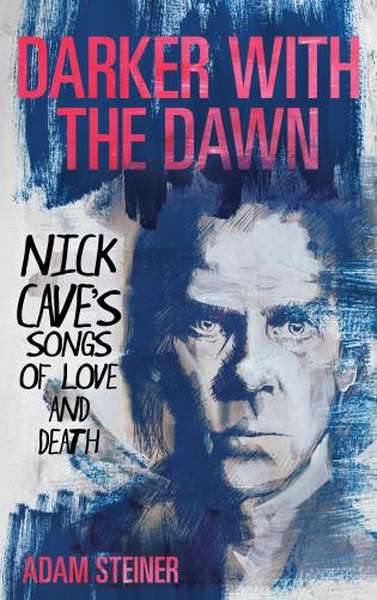
Adam Steiner doesn’t just break the earth with a spade with this book; he actually digs deep into the fertile soil to enter the cobwebbed crypt. He approaches the catalogue like a forensic scientist examining the maggots on a corpse—meticulously analyzing the rot and the details of decay to chart exactly how long the body has been decomposing. He gets his hands bloody and dirty digging into the thematic guts of Nick Cave’s work. Darker with the Dawn is a dense, post-mortem look at how Cave transitioned from the visceral, jagged noise of the Birthday Party years to the spectral, heavy-hearted weight of Ghosteen.
Crucially, Steiner maps out the deep, foundational timeline of how Cave's early love for raw Australian punk rock served as the volatile catalyst for his own path to enlightenment and artistry. The book charts his trajectory from a rabid, frontline disciple of Brisbane pioneers The Saints—whose frantic, hyper-kinetic energy completely blew the doors open for him and rewires his creative DNA—to channelled mimicry in The Boys Next Door, and then into the confrontational, unhinged theatre of The Birthday Party. Steiner demonstrates that the chaotic, self-destructive violence of those early Melbourne and London punk years wasn't a separate life, but the necessary, scarred chrysalis that allowed Cave to emerge as the leader of The Bad Seeds. Even when that trajectory threatened to grow too comfortable or stately, Steiner highlights how Cave detoured into the skronking, high-testosterone blues-punk filth of Grinderman—a mid-career palate cleanser that dragged the raw, primal noise of his youth kicking and screaming into the 21st century.
Most people listen to a record without overtly analyzing the lyrical content. There’s a reason a lot of punk and independent musicians don’t even bother including lyric sheets in their releases—they want the music to resonate on a purely visceral level and let the listener draw their own conclusions from the noise. But with Cave, the bloodlines run deeper. The standard rules don't apply. Steiner is able to directly decipher the ancient code, drawing direct parallels to Cave's subject matter and treating the lyrics like high literature.
In doing so, the book systematically dismantles the public caricature of Cave as some cartoon "Dark Lord of the Underworld." Instead, Steiner hands the reader a magnifying glass into a much more volatile reality: a creator constantly drowning in an ocean of human atrocity and profound personal grief while desperately reaching for the light. It recalls the global David Bowie Is exhibition—the way it put Bowie's personal books, childhood artifacts, and collaborations on display to show how he omnivorously consumed culture. Like Bowie, Cave synthesizes his output and regurgitates it like a bird feeding a worm straight into the listener's brain.
Crucially, Steiner traces these inputs back to the ultimate blueprint: Leonard Cohen and the deeper eccentricities of theology. We see the mechanics of how Cave operates like a blue-collar craftsman, bashing out lyrics and transgressive prose on a manual typewriter at a well-worn wooden desk—inheriting his father’s desk as a teenager, creating a rigid, 9-to-5 sanctuary. It's a structured mirror to Cohen's own legendary devotion, though where Cohen famously carried his loose, evolving lyrics around in a battered plastic grocery bag like sacred junk, Cave transformed his own transient, mid-flight thoughts onto airline barf bags for The Sick Bag Song.
At his desk, Cave took Cohen's structural DNA—the intermingling of the sacred and the profane, the Old Testament weight, and the concept of "hiding songs" that act as a refuge—and weaponized it. Steiner tracks Cave’s spiritual path as he moves from canonical scripture into the lost books of the Bible and the Apocrypha, mining those hidden, forbidden texts for nightmare landscapes and moral ambiguity. It shows how Cave learned that heavy, dark melancholia isn't draining; it's a vital, explosive source of creative energy.
Steiner isn’t interested in cheap gossip or standard rock-bio traps; instead, he pulls back the curtain on the "Southern Gothic" bones, the biblical obsessions, and the sheer architecture of the music. He rightly gives credit to how the Bad Seeds—especially crucial architects like Mick Harvey, Blixa Bargeld, and Warren Ellis—built the atmospheric grit that makes these songs of love and death actually land.
Steiner’s own prose can be as moody as a mid-period Bad Seeds b-side, but it’s an essential read if you care about the mechanics of the songwriting rather than just the public mythology. It’s a solid, non-polished deep dive that makes you want to pull everything from From Her to Eternity to Murder Ballads back out of the stacks to listen with fresh ears. If you’re into the archival history of post-punk or want to understand the dark alchemy of Cave’s songwriting, this belongs on the shelf.