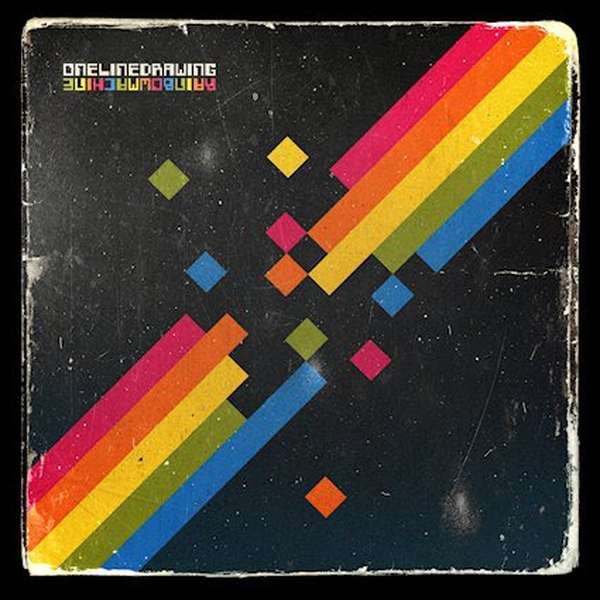
I grew up listening to the acoustic side of onelinedrawing. Those stripped-down Jonah Matranga songs had a way of making everything else disappear, often needing little more than a guitar, a voice, and an honest melody to completely pull you in. That's still the version of onelinedrawing that immediately comes to mind for me, so with Matranga having been relatively quiet for a while, I was genuinely excited to hear what RAINBOWMACHINE would sound like. Then "This Is A Warning" comes out swinging.
It's loud. It's rocking. It's ridiculously catchy. And it is definitely not the quiet acoustic onelinedrawing record I might have expected. That opening immediately establishes that RAINBOWMACHINE isn't interested in recreating the past. Produced by Jay Maas, the album takes the intimacy at the heart of Matranga's songwriting and surrounds it with layers of guitars, synths, distortion, and some genuinely huge production. At times it's punk. Elsewhere it moves through indie rock, emo, alternative rock, and atmospheric territory without sounding like Matranga is deliberately trying to check off genres.
For longtime listeners, there are also some wonderfully familiar electronic touches scattered throughout. They immediately reminded me of the strange noises Matranga used to pull from his little R2-D2 during live onelinedrawing performances. Those sounds were always part of what made the project so endearing. This one guy could make something incredibly personal while still being willing to experiment and get a little weird. RAINBOWMACHINE takes that same instinct and gives it considerably more room to play.
After the opening punch of "This Is A Warning," much of the album settles into slower and mid-tempo territory. That's not to say it loses energy. These songs simply aren't in a hurry. They find a groove, build an atmosphere, and vibe out for a while. Guitars stack upon one another, electronic sounds bubble underneath, and quieter passages gradually expand into massive walls of sound.
The production is fantastic throughout. For an album with this many layers, nothing feels unnecessarily cluttered. Matranga's voice remains the focal point even when everything around him gets enormous, and that's important because his ability to connect emotionally has always been the heart of onelinedrawing.
Many of these songs existed for years before finally finding their place here, having been written during different periods of Matranga's life. Knowing that makes the album's constantly shifting personality feel appropriate. RAINBOWMACHINE doesn't sound like a dozen songs conceived during the same three-month writing session. It sounds like pieces of someone's life finally discovering how they fit together.
There's also something beautifully imperfect about the whole thing. Matranga has never needed to sand every rough edge from his music. Anxiety and hope coexist here. Beauty gets interrupted by noise. A delicate melody can suddenly find itself surrounded by distorted guitars and electronics. The album can feel deeply personal one moment and surprisingly huge the next. Most importantly, it never feels like an artist looking backward.
With Matranga's history in Far, New End Original, Gratitude, and his other projects, nostalgia would have been an easy card to play. Instead, RAINBOWMACHINE sounds curious. There are certainly moments that will resonate with people who grew up on the alternative and emo music Matranga helped shape, but this isn't someone attempting to recreate what worked twenty-five years ago. And as someone who fell in love with onelinedrawing through those quiet, stripped-down songs, that's probably what surprised me most. The intimacy is still here. The vulnerability is still here. Those quirky electronic flourishes are still here. Jonah Matranga is unmistakably still here. He just brought a hell of a lot more amplifiers this time.