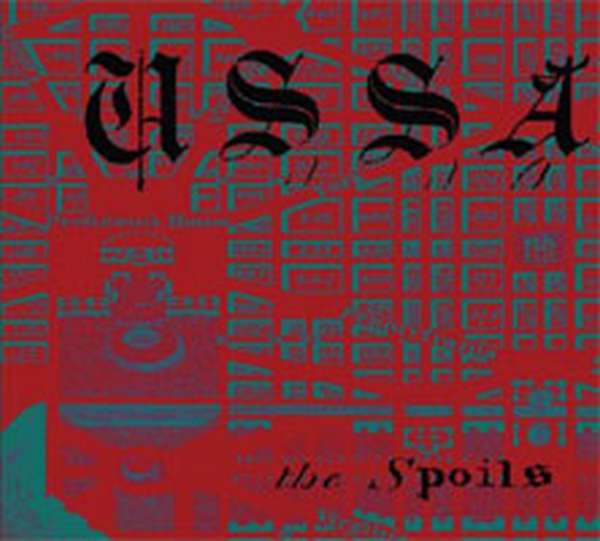
U.S.S.A. is a relatively new project consisting of Ministry's Paul Barker, Tomahawk's Duane Denison and
two other guys. Two out of four guys that have had some level of fame does not make a "supergroup," a word seemingly thrown around any time a dude from one known band happens to get together with one or more dudes from another known band. But for those familiar with both artists, the collaboration between these two gentlemen should be reason enough to check this group out just the same.
Their debut album, The Spoils manages to yield quite a few surprises. At first you'll be surprised at the whole D.I.Y thing of it all, a relatively small (in marketing strategies, anyway) release through seemingly not so much a label as an independent artist's collective known as Fuzz Artists.
The next big surprise is the band's music. One would think a cool amalgam of industrial Ministry / Lard / Revolting Cocks mixed with the coolness of a Jesus Lizard / Tomahawk kind of a thing and you'd be half right. The latter half, that is, because U.S.S.A. sounds pretty much exactly what we'd always come to expect from Tomahawk, with the exclusion of their last album, the polarizing Anonymous. But for all who disliked Anonymous, the groove-oriented chugga-chugga rhythms are back. All of this is a good thing, mind you. It's just puzzling that Barker's contributions are seemingly so minimal. It isn't until more than halfway through the album that Barker's influence is felt on the ball-stomper "Forget Yourself."
From Denison's signature guitar work in opener "Dead Voices" to the slower-tempo almost Steel Pole Bathtub-esque "Wasteland," there isn't an ounce of wasted space on this album, which, I can say in all sincerity that had it been reviewed three months ago, it would have been in at least my top fifteen records of the year. Singer Gary Call was a good find for the band. He's a very versatile vocalist that serves the music well. If this lineup was maintained and there was never another Tomahawk album, it wouldn't be the worst thing in the world. I mean, whatever treats Mike Patton always brings to the table, Tomahawk was first and foremost Denison's project and while their albums were strong in their own way, I would even go so far as to say that The Spoils is a stronger entry than any of them or, at the very least more consistent.
I think I've just touched on what my trouble with Tomahawk has always been. While I've always enjoyed Patton in whatever he's associated himself with, Tomahawk just seemed like an awkward fit. For a guy who's gone from Mr. Bungle to Fantômas to his Mondo Cane project, a more mainstream (though not in the denigrating sense of the word) project feels ill-suited for a guy who's best at his most experimental. U.S.S.A. feels more organic and fitting to what Denison's trying to do and for fans of his music. You can't get better than that.