Defiance, Ohio - political southern-influenced punk rock. We sat down pre-Fest to chat with Geoff, guitarist and vocalist.
Scene Point Blank: I'm going to start with some Fest questions, since that's at the heart of this piece. How many Fests have you played?
Geoff Hing: I want to say this will be our third or fourth fest. It's hard to keep track because we haven't played every year since our first one.
Scene Point Blank: Do you have a "Greatest Fest Memory"?
Geoff Hing: I don't have any really epic memories, but I had a really good time playing kickball last year and meeting nice people from all over. I remember seeing Bitchin' play the first Fest that we played and just thinking they were really awesome. I had a lot of fun improvising really strange thrift store Halloween costumes one year.
Scene Point Blank: How many of the band's other projects are also playing Fest?
Geoff Hing: Landlord, a band that Will plays bass in is playing at Boca Fiesta on Sunday. Theo is playing solo songs on Saturday at the Civic Media Center.
Scene Point Blank: How are you getting to Gainesville? Are you touring?
Geoff Hing: Ryan, Theo, and Will are all touring with other musical projects. Bz and I are flying. We did a short but awesome tour at the beginning of the fall and then I had to go back to Chicago to finish up school, so we're not touring to the Fest.
Scene Point Blank: What are you studying? Are you almost finished?
Geoff Hing: I'm working towards a masters degree in journalism. I'll be done in December.
Scene Point Blank: Since the band members aren't based in the same city, how has touring changed? Does the full band go, or are only some members available?
Geoff Hing: Throughout the band's existence, a lot of us have lived in different cities. Even now, Theo lives in Athens while Bz, Ryan and Will are all in Bloomington, but he's really involved in setting up tours, writing songs and all other aspects of the band. I'm not as much, largely because of going to school and just feeling like I'm in a separate world from music that takes up a lot of time right now.
I've been away for parts of recent tours, but that's been the case for Sherri and Will in the past too. So I don't know how much it's changed overall – it's just changed for me.
Scene Point Blank: You recently played a couple shows with Bouncing Souls. How was that?
Geoff Hing: It was pretty interesting. One thing that really struck me was getting to the club and just realizing how many people were involved with the show. It was a big production to have three bands load in, get set up, do a sound check if there was time and then to see all the club workers getting ready too. It was sort of exciting, but it was also strange that for a lot of people, it was just another day at work.
Folks in the Bouncing Souls and The Great Explainer, the other band that played those shows, were nice but, because the shows were in cities where we all had a lot of friends, it didn't really feel like we had time to hang out.
It also felt strange to be separated from the audience, either by a barrier or by the height of the stage or the brightness of the lights.
Scene Point Blank: How do you like playing bigger shows like that? Is it harder to get the proper acoustics for your instrumentation, or doesn't size affect that?
Geoff Hing: Well I'd say the instrumentation isn't the biggest concern. There are challenges to how things sound, especially when there isn't time for sound checks, but there are different challenges with getting things to sound good in a basement too. It's nothing new. I think the biggest change is just being so disconnected from the audience: whether it's by a barrier, the height of the stage, or just not being able to see the crowd because of the lights.
We played on this giant stage to a pretty big crowd at this benefit in Chicago called Brew Not Bombs that some of our friends set up. It was in this neat, giant old theater so that was cool, but it was really hard to see the audience or to feel connected. At one point, there was some violence between security and someone in the crowd and the disconnect made it really hard to figure out what was happening and what we should do about it from on stage.
Scene Point Blank: Were you able to figure out what happened, or did you just move on? Do you think there's a way to avoid that disconnect without playing on the floor itself?
Geoff Hing: Not until after we played, and even then it wasn't entirely clear to me. During our set, we acknowledged that something was going on, and I made sort of a vague "cut it out" kind of statement, but I don't know how useful that was.
Scene Point Blank: Do you think there's a way to avoid that disconnect without playing on the floor itself? I don't think the disconnect is just a function of tall stages or lights. When it's a big, crowded space, it's hard to assess everything that's happening in the crowd, even if you're at ground level. I think that just having a situation where people feel accountable to one another, to the people setting up the show and to the space helps everyone - us included - feel more connected.
Scene Point Blank: How did you go over with the Bouncing Souls crowd?
Geoff Hing: It felt really different between D.C. and Brooklyn. In D.C. it seemed like people were pretty interested in both us and the Bouncing Souls. In Brooklyn, not so much. There were a handful of people up front in Brooklyn who were really stoked and some folks who started a circle pit, seemingly to occupy themselves, which I can totally get behind, but in general it felt like folks were just waiting for the Bouncing Souls to start.
Scene Point Blank: Do you like playing to a new crowd like that, or do you prefer a tour where you're the headliner and people are already interested in your band?
Geoff Hing: Well, I'd say we always like to play to new people, and being the headliner doesn't really matter, as long as people seem interested. It's also hard when there feels like a disconnect between us and the audience that goes beyond a stage or a barrier or attention spans. After the show in Brooklyn was over, a group of guys left the show chanting "USA! USA!" That kind of mob patriotism sort of rubbed me the wrong way. I sort of felt like, "Where am I?" Of course, "Up the punks!" can be just as narrow or mob-ish sometimes. So maybe the reality check that can come with new audiences and new places - on tour and in life, in general - is a good thing.
Scene Point Blank: Going back to the idea of having band members spread out in different cities: Has your songwriting process changed because of this?
Geoff Hing: I think we spend less time putting things together: little pieces or starts of songs that people have don't get developed in the way that they might have in the past. But, throughout the course of the band, we've always had each member as a songwriter bringing almost-finished songs to practice that the band then helps edit and I don't think that's changed dramatically. It's still one of the things I find amazing about playing in this band, and that I take for granted - playing in a band with three or four other songwriters.
Another thing that's changed, though, is that since we're touring less, songs don't get the chance to evolve playing at shows before they're recorded.
Scene Point Blank: You've released three records in the last four years. How do you keep up the pace? Is it a conscious effort, or have you just been in a creative groove?
Geoff Hing: Is that a fast pace? It feels so slow sometimes. I think just having so many people in the band writing songs means that we always have things to learn, re-work and record.
Scene Point Blank: Most of your songs have some kind of political theme without becoming jingoistic. Do you see music and social activism as intertwined?
Geoff Hing: That's nice of you to say. I think one of the unfortunate tropes when people write and talk about music is that bands are either "political" or not, when I think that most music doesn't really fit into such a simple rubric. I think everyone in the band is a pretty thoughtful person who tries to understand their world and the natural outcome of that is songs that reflect a cultural climate, histories and the movement within those contexts. Also, though I think we'd all identify ourselves as progressive in our politics, there's still a huge range of perspectives, priorities and ways of expressing those things among the people in the band. I think that ends up reflected somehow in the songs and the way we talk about them when we perform.
Of course music and social activism are intertwined. Whether it's a Phil Ochs or Nina Simone song during the civil rights era, or a song like "God Bless the USA" that's popular with conservative activists, music often seems to consolidate the ideas or emotions connected with movements. More personally, I don't know if Defiance, Ohio would exist if I hadn't met Will when we were both involved with Columbus United Students Against Sweatshops as college students. I think collaborating for a cause translates well to collaborating to make music.
Scene Point Blank: Care to elaborate on that? Do you mean it involves similar people skills?
Geoff Hing: I think it's just a similar mix of idealism and confronting realities: being really excited but also facing a lot of hard work. There's also the aspect of trying to be really intentional and clear about what you're trying to say. In terms of "people skills," like with any collaborative project, there's a certain amount of compromise that's required, or better yet navigating conflict so when you finish, it feels like you're in a new place where no one feels like they're unhappy with the outcome.
Scene Point Blank: Have your views gotten you into any trouble booking tours or playing shows?
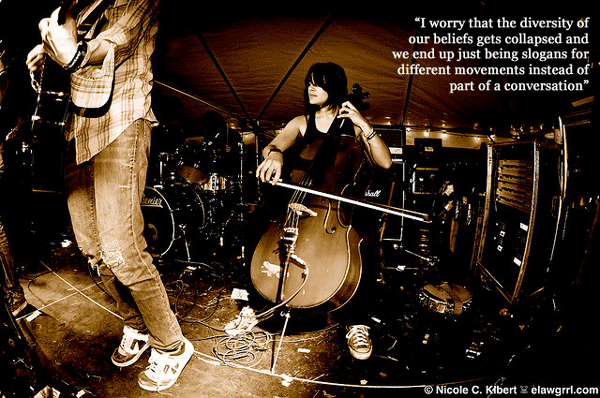
Geoff Hing: Nope. Not as far as I can remember. In some ways, I think the politics get fetishized and that makes it more appealing for people to book shows for us. I worry that the diversity of our beliefs gets collapsed and we end up just being slogans for different movements instead of part of a conversation.
Scene Point Blank: This isn't really related to anything in the discussion so far, but—to close out the interview—does anybody in the band have any ties to the city of Defiance, or was it just a fitting name?
Geoff Hing: We don't, though everyone except for Theo spent a significant part of their lives living in Ohio. It was a band name that spoke to the resistance that is implicit to punk and also the experience of being in the Midwest. It can be both a resilient and cantankerous place.
--
Photos: http://www.flickr.com/photos/elawgrrl/