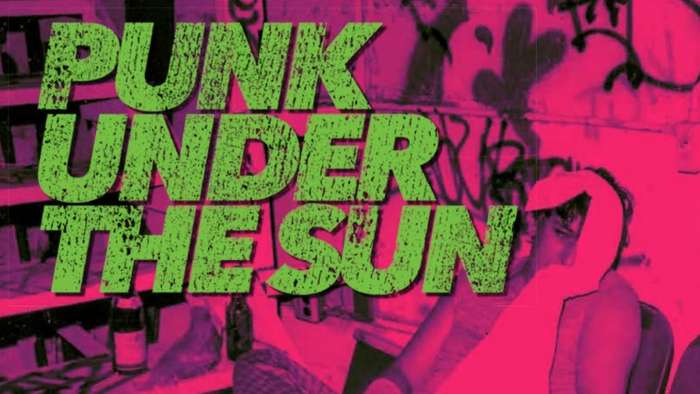
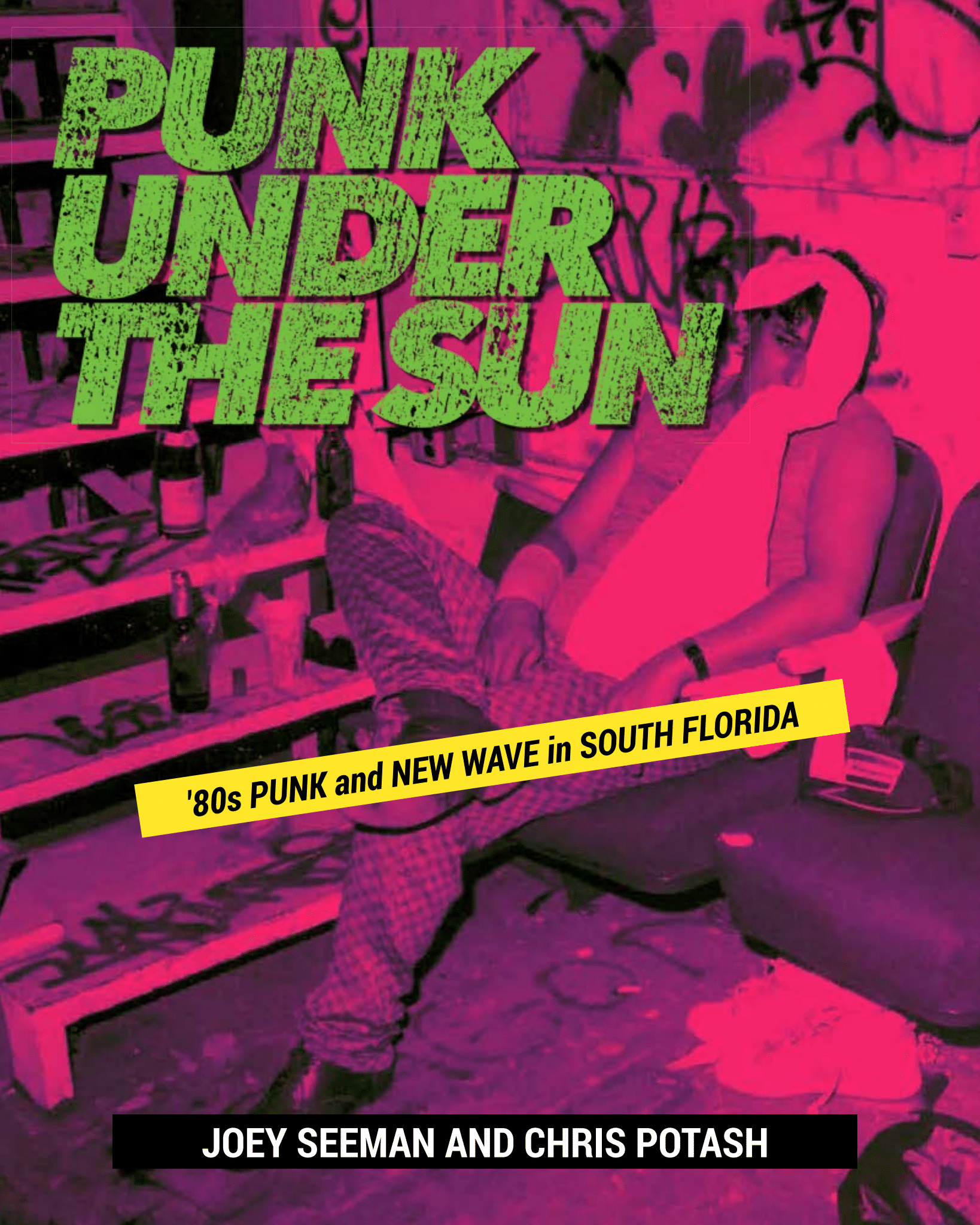
Punk Under the Sun – Interview with Joey Seeman and Chris Potash
Some music scenes become legendary — New York, London, Los Angeles — but others almost vanish without a trace. South Florida’s early punk underground is one of those nearly forgotten worlds: sweaty, chaotic clubs that appeared and disappeared in months, flyers taped to telephone poles, demo tapes with no label, and Polaroids curling at the edges. It was a scene built on curiosity, rebellion, and a deep love of sounds: from the raw swagger of the New York Dolls to the bass-heavy rhythms of reggae drifting up from the Caribbean.
In Punk Under the Sun, Joey Seeman and Chris Potash rescue this disappearing history, documenting the bands, venues, and cultural crossovers that defined a time and place. From secret East Coast tours and estate sale record finds to the unexpected influence of Bob Marley on Florida punks, their book captures a scene that might have been lost forever.
Scene Point Blank spoke with Joey and Chris about surviving scattered venues, navigating addiction, collecting records as archival treasure, and the thrill of piecing together a patchwork of music history. Their conversation brings the forgotten Florida punk scene to life, proving that even the most regional underground movements can leave an indelible mark when someone takes the time to preserve them.
Scene Point Blank: Your book brought back a flood of memories of my first trip to Florida. I was about 17 and saw a flyer for the Butthole Surfers at the Cameo Theatre. I ripped it off a pole and begged my dad to take me. The band name alone shut that down. But I kept that flyer on my wall for years.
Joey Seeman: That’s amazing. I might still have extras of that flyer somewhere in a box. Those shows were overwhelming. If you didn’t know what you were walking into, it could feel dangerous. Two drummers, war footage, smoke machines, and strobe lights. It wasn’t just a concert — it was an assault.
Chris Potash: You didn’t need drugs at a Surfers show. The show was the drug!
Scene Point Blank: When I visited Miami in the late 1980s, South Beach still had a gritty feel, but I couldn’t find the scene. I knew punks existed. I even dragged my dad into a gay leather shop in The Keys to buy studs for my leather jacket. But the shows were invisible.
Joey Seeman: That was the reality. If you didn’t know someone, you didn’t know where to go. Flyers were everything: telephone poles, record stores, word of mouth.
Chris Potash: Florida wasn’t centralized. It wasn’t CBGB’s. It was scattered. One week it was a bar on South Beach, the next it was somewhere in Fort Lauderdale, and then that place would close.
Joey Seeman: That instability forced people to be connected. You followed people, not venues.
Scene Point Blank: What made the venues unique?
Chris Potash: They were temporary. That’s the best word for it. Clubs would exist for six months, maybe a year. Then zoning laws, noise complaints, ownership changes — they’d vanish.
Joey Seeman: And the crowd changed depending on the area. Some venues leaned toward art school because of the Art Institute in Fort Lauderdale. Others were biker bars where punks had to hold their ground.
Chris Potash: That tension shaped the sound. It wasn’t polished. It was survival music.
Scene Point Blank: How did Florida connect with the broader underground?
Joey Seeman: Touring. Bands from the Northeast would come down, and Florida bands would head north. Playing places like Philadelphia or Camden was eye-opening.
Chris Potash: You’d suddenly see different production standards, different audience reactions. In some cities, punk was institutionalized. In Florida, it was still scrappy.
Joey Seeman: Those trips also meant record trading. Zines. Addresses. Before the internet, that’s how scenes connected.
Scene Point Blank: This has come up in interviews time and time again. Joey Shithead (D.O.A) would give you names from his little black book. Sounds old school, but that is how it happened. A sense of community.
There’s a strong glam undercurrent in Florida punk, from what I understand.
Joey Seeman:Definitely. The New York Dolls were a blueprint. Swagger, looseness, attitude.
Chris Potash:They showed that imperfection could be powerful. That theatricality seeped into Florida bands.
Joey Seeman: When Sylvain Sylvain passed away, it hit hard. Even if you never met him, you felt connected to that lineage.
Scene Point Blank: Interview over… this is where we talk about the New York Dolls. I once interviewed Derek from Simple Minds, and that is all we spoke about over a beer or two. lol.
One of the most fascinating threads in your book is reggae’s presence. Florida isn’t just geographically southern — it’s culturally Caribbean. How did that shape punk?
Chris Potash: You couldn’t grow up in South Florida and not feel reggae’s presence. Record stores stocked dub and roots alongside rock imports. DJs mixed it into club sets.
Joey Seeman: When Bob Marley toured Florida, it wasn’t just another show. It was cultural validation. Reggae wasn’t “world music” there — it was local.
Chris Potash: Marley’s Florida appearances had a ripple effect. You’d have punks who went to those shows out of curiosity and came back obsessed with bass tone and rhythm. Dub production techniques — space, echo, minimalism — crept into how bands thought about sound.
Joey Seeman: And South Florida radio sometimes played reggae more openly than northern stations. That exposure mattered.
Scene Point Blank: So Florida punk wasn’t just borrowing from New York and London — it was absorbing Kingston.
Chris Potash: Exactly. That proximity created something unique. The aggression of punk with the rhythmic undercurrent of reggae.
Scene Point Blank: Any personal stories about encountering Bob Marley or the scene around him?
Joey Seeman: My guitar player ran into Marley at a music store on US-1 near Dadeland in South Florida. Marley’s family had a house there. It was surreal — one moment lessons, the next moment, Bob Marley casually browsing guitars.
Scene Point Blank: I remember my first real concert: grade 8, Peter Tosh. Everyone stood on their seats. He came out in a long white flowing robe, hailed Haile Selassie, and then smoked a joint the size of an arm. That’s when I realized how many people in the world actually smoke marijuana.
Chris Potash: That sounds wild, but it shows how interconnected the cultures were —reggae influencing punk, street culture, and musical curiosity.
Scene Point Blank: Something that comes through strongly in the book is how fragile underground history really is. Entire bands can disappear if no one documents them.
Chris Potash: That’s exactly what we started realizing as we worked on it. People assume scenes are automatically preserved because music exists, but most local bands never had proper releases. Maybe they had a demo cassette. Maybe a 7" pressing of a few hundred copies. If those things aren’t saved, the band effectively vanishes.
Joey Seeman: And it’s not just the music. It’s the context: who opened for whom, which venues existed, who was connected to what. Once the people who remember those details start passing away, the gaps get bigger every year.
Chris Potash: There were musicians we wanted to interview who had already died before we even began reaching out. That’s when it hit us: this wasn’t just a book project. It was an archival rescue effort.
Scene Point Blank: Many underground communities also carried a darker reality: addiction, burnout, and people stepping away entirely. Was that something you encountered while documenting the history?
Joey Seeman: Absolutely. Punk scenes are intense environments. They’re creative, but they’re also fueled by extremes — late nights, substances, unstable income, constant movement. Some incredibly talented musicians just disappeared from music altogether because life caught up with them.
Chris Potash: And sometimes you’d reconnect decades later and realize someone who had been central to the scene was barely mentioned anywhere. No recordings online. No interviews. Maybe just a flyer in someone’s attic. It really drives home how quickly cultural memory can fade.
Joey Seeman: That’s part of why we tried to include as many voices as possible, even people who weren’t necessarily the “biggest” names. Scenes are ecosystems. Remove the smaller bands, the promoters, the venue owners, and the story stops making sense.
Scene Point Blank: You both talk about collecting records almost like it’s archaeological work.
Joey Seeman: It really is. Every time you find a local pressing, you’re recovering a fragment of history. Sometimes the only surviving evidence that a band existed is a 45 someone saved in a box for thirty years.
Chris Potash: Collectors sometimes get a reputation for hoarding, but many of them are actually preservationists. They keep things safe long enough for historians, writers, or labels to rediscover them.
Joey Seeman: And the discoveries don’t always come from record stores. Estate sales are huge. Families clearing out houses often have no idea what they’re sitting on — boxes of singles, photographs, ticket stubs, even unreleased tapes.
"Every preserved memory strengthens the historical record." – Joey Seeman
Scene Point Blank: Have you personally experienced major finds like that?
Chris Potash: Oh yeah. You walk into a sale expecting nothing, and suddenly there’s a crate filled with regional punk singles. Sometimes they’re organized, sometimes they’re just stacked in a garage. You realize you might be holding the last surviving copies of something.
Joey Seeman: There was a moment when I opened a box and found multiple early local releases that I hadn’t seen in decades. That’s when you realize how much music history is sitting quietly in people’s closets waiting to be rediscovered — or thrown away.
Chris Potash:That’s why we always tell people: before you discard old media, ask around. Someone somewhere is probably trying to research that exact scene.
Scene Point Blank: Florida punk often gets overshadowed by bigger coastal scenes. Do you think that’s changing?
Chris Potash: I think so. Once people started hearing reissues of Florida bands, they realized how distinctive the sound was. It wasn’t trying to replicate New York or Los Angeles. It had its own identity.
Joey Seeman: Part of that identity came from geography. Florida was both isolated and internationally connected. You had Caribbean influence, tourists bringing in records, touring bands passing through, and local musicians absorbing everything at once.
Chris Potash: That combination created something harder, faster, and sometimes stranger than what people expected from the region.
Scene Point Blank: One thing I loved in the book is the visual material: flyers, photographs, ticket stubs. Why were those details important to include?
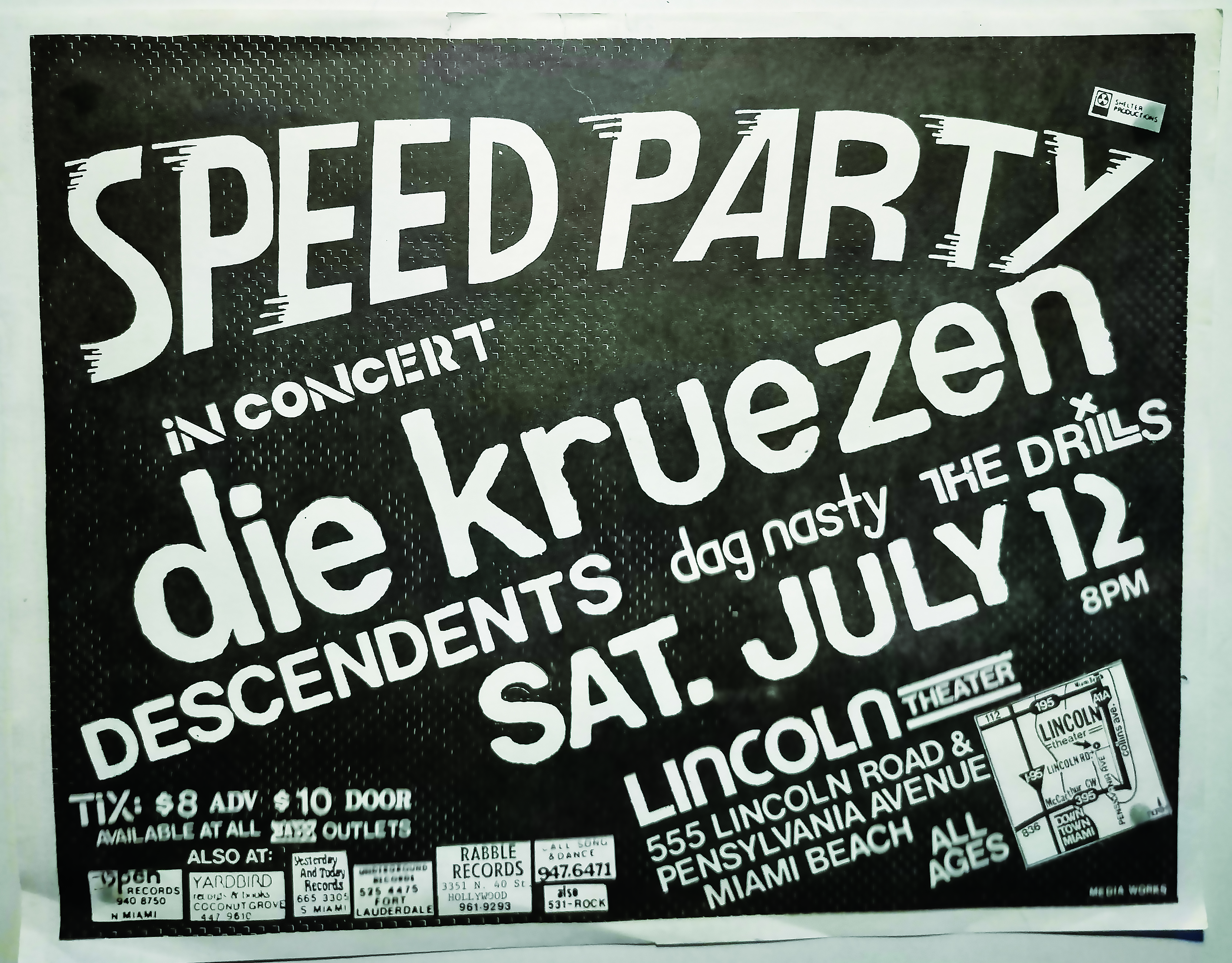
Joey Seeman: Because they prove the story. Anyone can say a scene existed, but when you see a flyer with a lineup, a date, and a venue, suddenly it’s real.
Chris Potash: And flyers tell their own story, stylistically. The artwork shows the influence of the time, such as DIY collage, photocopy aesthetics, and hand-drawn lettering. It’s a visual record of how the scene saw itself.
Joey Seeman: Plus, flyers often include bands that never recorded anything. Without those pieces of paper, those names would be gone completely.
"The aggression of punk with the rhythmic undercurrent of reggae created something unique." – Chris Potash
Scene Point Blank: Florida’s location meant people were constantly moving through — tourists, musicians, immigrants. Did that constant motion shape the scene?
Chris Potash: Very much so. You’d meet someone at a show who had just moved from another city and brought a completely different musical background. Suddenly, new sounds entered the scene overnight.
Joey Seeman: And because Florida cities were spread out, people travelled between them constantly. Miami, Fort Lauderdale, and West Palm — each had its own microscene, but they were interconnected.
Chris Potash: That movement kept things evolving. The scene never stayed static long enough to become predictable.
Scene Point Blank: Do you think modern scenes are better protected from disappearing because everything is online?
Chris Potash: Not necessarily. Digital media can vanish faster than physical media. Hard drives fail, platforms shut down, accounts get deleted. If material isn’t backed up or archived properly, it can disappear overnight.
Joey Seeman: At least with a box of flyers, someone can rediscover them fifty years later. A lost website might be gone forever unless someone intentionally saved it.
Chris Potash: That’s why preservation has to be active. Scan things. Save files in multiple places. Share copies. Scenes survive when information spreads, not when it’s locked away.
Scene Point Blank: After finishing the book, did your perspective on the scene change?
Chris Potash: Yes. When you live through something, it feels chaotic and temporary. When you document it decades later, you see the pattern of how the venues, the musicians, the influences, and the cultural shifts all connect.
Joey Seeman: And you realize how many people contributed to something meaningful without ever receiving recognition. That’s one of the most rewarding parts of projects like this — bringing those names back into the conversation.
Scene Point Blank: If someone reading this interview was part of a local scene, any scene, and never documented it, what would you tell them?
Chris Potash: Start now. Write down what you remember. Scan your photos. Label your recordings. Even small details matter.
Joey Seeman: And talk to people while you still can. Memories fade, and once someone is gone, their stories often go with them. Every preserved memory strengthens the historical record.
Chris Potash: Scenes don’t survive automatically. People keep them alive.
Scene Point Blank: Any final thoughts for readers?
Joey Seeman: Even regional, “forgotten” scenes matter. Every city has stories waiting to be told. Document, preserve, and share.
Chris Potash: Punk Under the Sun isn’t just a retrospective. It’s proof that dedicated documentation can save cultural history.
---
In telling the story of Florida’s punk underground, Joey Seeman and Chris Potash do more than revisit a regional scene — they reconstruct a cultural ecosystem that was never meant to last. The short-lived venues, the scattered shows, the DIY flyers, the touring circuits that stitched cities together, the glam lineage, and the deep reggae pulse all formed something volatile and uniquely local.
What makes Punk Under the Sun resonate isn’t just nostalgia. It’s the recognition that history is fragile. Entire movements can dissolve if no one preserves the artifacts, the recordings, and the stories. In an era where digital culture can disappear as quickly as a shuttered club, documentation becomes an act of respect.