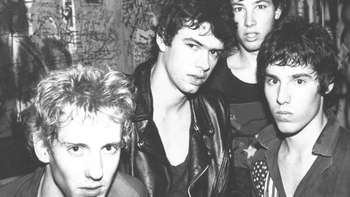
SPB's Graham sat down with Katie Sketch of The Organ, who were conceived in 2001. Beginning her musical training at three years old with classical violin training, it's safe to say that Katie's life was always going to involve music. SPB talked to her to find out a little more about her band, their label, and life.
Scene Point Blank: Would you mind introducing yourself for the tape recorder and all the people who will be reading this interview?
Katie: My name is Katie Sketch from The Organ.
Scene Point Blank: First of all I wanted to say thanks a lot for taking the time to sit down with me today. You guys have been touring pretty extensively as of late, going all across North America and hitting up Europe later this month. What have your experiences on the road been like and how have the crowds responded?
Katie: The crowd reactions been really good. If the crowd reaction isn't good it's because there has been no crowd, which is a completely different issue; for the most part it's been really great. Touring has been successful which is why we're continuing to do it, otherwise we'd just stop and write our next album. If you're building up a fan base and it's going well you have to just keep touring and hopefully word or mouth gets around.
Scene Point Blank: The Organ is signed under a joint deal between the 604 and Mint record labels. While Mint has been known for it's Indie rock , helping produce bands like The New pornographers; 604 is known for being Nickleback's record company. It sort of seems like an odd combination, how did it come about?
Katie: It came about because Jonathan from 604 was desperately trying to sign us for along time. He was really aggressive, not in a bad way, but he called me every day and we had meetings all the time. I couldn't understand the connection between his labels and our band, because we aren't similar at all to the bands that he normally deals with, like you said. When he asked me what kind of label I wanted to be on I said Mint. At the time they actually had offices in the same building. We were friends with the Mint people, so he called some people there and asked them if they wanted to do a joint deal, and he did so it just worked out. When I said at the time we wanted to be on Mint I didn't foresee that happening, it just took place.
 Scene Point Blank: So it's worked out well then?
Katie: It did work out well. If it's not working out then I really don't know about it. They have to deal with it. I think they work well as a checks and balances system and that's why I thought it was a good idea. You sit and see what could happen. You shouldn't necessarily do experiments with your career but it seemed like a good one to try and take on.
Scene Point Blank: Now that you guys actually have a record deal, how do you feel about the internet culture of downloading and sharing music? How important is the internet for exposing smaller bands?
Katie: I think it's good. A lot of people who are wigged out over free music trading are the people that make enormous amounts of money. For the smaller bands it's good because it gives exposure and gets people to come out to shows. People can email somebody a track and it works in our favour. It doesn't work in the favour of bands who are concerned with or making a lot of money.
Scene Point Blank: Since the Organ is now your job, and you guys have picked up a contract, is there more pressure to preform and prove yourselves? Or is the pressure off because you've got a label?
Katie: I don't know if it's more or less actually. I think it's ... well no it's probably more to a certain extent. When we quit our jobs to do the band then obviously we need to collect revenue for five people and that's a lot of money. We're not necessarily a band that makes that much money. We have a label in Canada but we don't have a label in the States. The States is generally where the bands make their money because of the amount of people, and amount of big cities. So that is a stress, and a strain, on some level. We need to be signed in the States so we can tour but at the same time we're not going to sign to just any label. It needs to be right for us.
You know, we've always put our selves under a lot of pressure from the beginning; right from the very first practice, to the first show, to the first tour, and till now. It's probably increased abit but only by alittle bit.
Scene Point Blank: So what are your expectations for the band?
Katie: Um... we don't really have expectations? ( laughs ) I think the expectations we put on ourselfs is we want to write good songs, play well, and play to people. It's a trick to figure out how you're going to do that. That's what we spend our time thinking about and focussing on music. I think that if a band puts harsh expectations on record sales and getting people to like them, they're setting themselves up for sever failure. There are way too many factors that come into play that are out of your control.
Scene Point Blank: There are always constant comparisons going on between you and other bands, which I don't really need to get into. What do you think is the fixation from critics and journalists to label your band?
Katie: Generally speaking I think it's fine that they do that. I think the fixation is that they need to make some sort of reference so people know what they're talking about. Music is one of the hardest things in the world to describe. You can describe tones but still you don't even know what the band would sound like. So if someone says you know.. they sound abit like... or they sound a lot like the Smiths then people know whether or not they might like that band. They'll have some sort of grasp we're not going to sound like Missy Elliot or something, you know? I think it's necessary.
Scene Point Blank: How about the focus on the lyrics of the band? A lot of people have said your music can be really depressing when I don't quite see it that way. What's your reaction to that?
Katie: I don't know. I don't really have much of a reaction to that. Sometimes I say something and somebody can relate to it. They might not see it as being negative. Other times I'll read something and they'll say I couldn't listen to this for longer than five seconds because it was too depressing and too irritating to listen to. That's fine. I feel that way about other musicians and bands.
Scene Point Blank: You're very picky with the lyrics you'll actually put on to the record. Rewriting them until you guys actually record. Why?
Katie: Simply because I say something and I don't feel that way the next day. If you're going to sing a song right million times, you want to believe what you're saying on some level. That's how it is for me, or else I don't understand what the point of singing would be. Often times I'll write a line that I think is great and a week later I'll think it's the cheesiest , or that it doesn't make any sense, or I'm speaking gibberish, or whatever. It makes me things more interesting and gives me something to think about in the van.
Scene Point Blank: You guys are known for being quite humble and modest performers and people. Are you more comfortable playing now, or is it still nerve racking?
Katie: Some shows it's really easy to get on stage and some shows it's still really difficult. We're still striving to do better, and that can be really stressful and difficult. Even tonight because of the disorganization of the show I feel completely wigged out. I'm nervous about it, but we played that festival in France and we were suppose to play in front of 10, 000 people. We we're freaking out... I mean really freaking out. It kind of depends. I can play in front of 100 people no problem, but last week we did that and the power went out and I got all nervous again. So it depends.
Scene Point Blank: That festival was with the Cure, was it not?
Katie: Yeah, the whole thing was surreal. Thankfully we were in the middle of a tour and kind of in the grove otherwise we would have been screwed. If we would have been playing that in the first few shows it would have been really, really, stressful.
Scene Point Blank: Jenny, your organist, was quoted as saying until a couple of years she was a completely different person and couldn't really talk to people, but when she started playing in a band it opened her up. What is it about music that can do that for people, or what does music do for you?
Katie: I'm not sure what Jenny meant by that. I'm assuming that she meant music gave her an identity. When people are in bands I think they sort of form and identity around that band. They're in a close knit circle with friends and they have reason for doing something that's important to them, if not to other people. Maybe that's what she meant by that. I'd be lying that I'd feel similarly if I wasn't in a band tomorrow. I think I'd feel really isolated to not be a part of the group.
Scene Point Blank: Thanks a lot for doing this, I'm going to finish up with asking what have your top 5 records of the year been?
Katie: Oh god..... I don't even know what year we're in.
Scene Point Blank: I think it's 2005.
Katie: Are you sure?
Scene Point Blank: Maybe we should just leave it at that.
Interview by Graham