A post-rock review is always a challenge. If you think it’s tough to capture the attention of an audience and carry them on your journey, musically, for 45 minutes without lyrics or choruses then try writing about that action. The successes and failures of the genre come in the ebb and flow, the storytelling, atmosphere, and ability to pull away from convention in what started as new but has now become a full-on genre with its own predictable tropes.
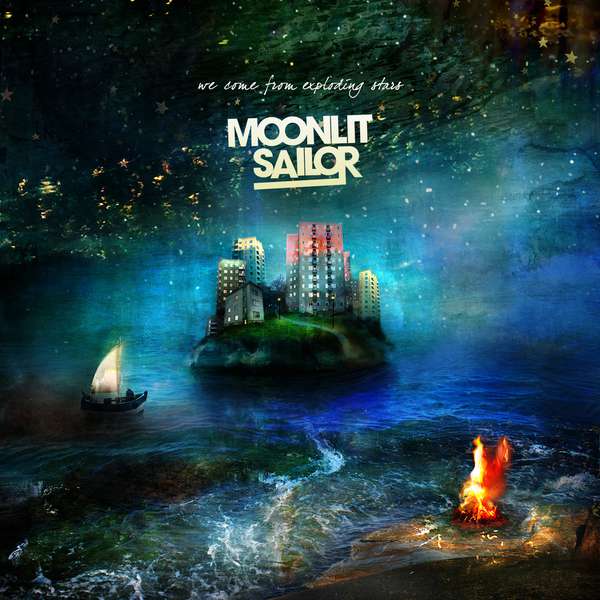
Moonlit Sailor is a Swedish quartet who play atmospheric and driving post-rock. It’s dramatic at times, but the definition of their work really comes in the ability to take a song from one movement to another in a coherent storyline devoid of lyrical accompaniment. As a whole We Come From Exploding Stars is a sea change. It’s about, to grab it straight from the band, exploring new waters, meeting and administering new challenges. With that new experience comes exploration, failure, climax, and eventually familiarity and growth. It’s a process but one driven by emotion more than formula. On the record they explore all of these themes in a sweeping, crashing, comforting, and surprisingly energetic journey.
Expoding Stars starts big, hitting on epic moments only 3 minutes into the record in the track “Minutes from Somewhere Else,” but they aren’t Explosions in the Sky-styled heavy drama. Instead they use that peak to stir up energy, transitioning into their watery journey that surfs up and down, returning to those early epic themes established in the first act. The record returns to similar ideas throughout and it’s an album here all the way. Though the tracks could also standalone nicely, the dramatic elements come through a careful exploration that returns and re-examines ideas rather than going in 10 different directions.
As the record explores new domains, there are some shades of ‘80s synth-pop captured in “From Gemini to Lynx” and later, in “Dollar Underwater,” there is a strong underwater atmospheric presence. It’s subdued and smothered, pulling its way upward from the struggle. The journey explores a lot of territory, ending with a louder and more driving rock pulling its way out of the exploratory structures. “4.15 AM” has hints of metallic guitars and big, loud moments, but it’s no chugging chord or rollicking solo; it effectively crescendos while playing in familiar keys. It doesn’t aim for the epileptic dramatic finish that certain post-rockers do, rather it ties the story together, climaxes, and wraps the story in a nice little epilogue. It’s complete but not overstated, wandering yet concise.