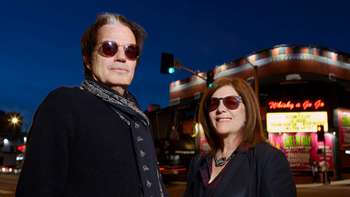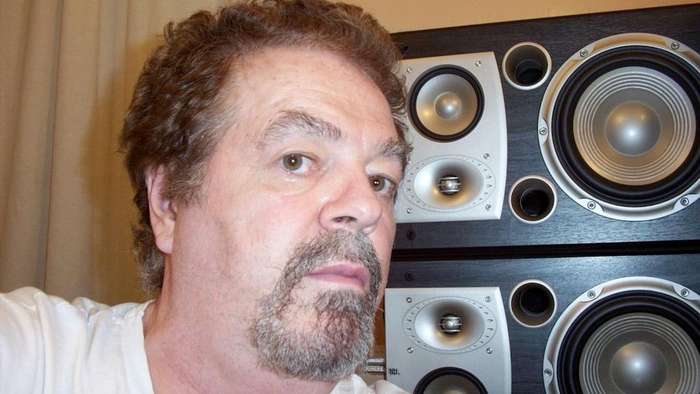
It's Hammer Time... well, Terry Hammer time, that is!
Terry started working for the college radio station KALX in 1978 and within that year soon began recording/documenting live performances by local bands. To take it a step further Terry approached KALX and was soon broadcasting these bands giving them exposure that few radio stations were doing at the time. As punk started catching on, Terry took it a step further once again and started broadcasting a 4-hour show totally dedicated to punk/new wave and reggae. Terry continued to record live shows until 1981 when other opportunities presented themselves, such as managing bands and mixing sound. In 1982 Terry became the manager of the well-regarded band Toxic Reasons and soon after was recording the classic album Independence.
The list of shows that Terry recorded is extensive (see link below). Terry recently sold this treasure trove of recordings to Liberation Hall who have released a handful of them already.
Many are ecstatic that Terry took the time to preserve this exciting period and pass the music on for other generations to explore and enjoy.
I recently had the opportunity to speak to Terry about his recordings, history and dedication. Read On.

Scene Point Blank: Initially, how did you become interested in music? Who originally first piqued or massaged your musical third eye?
Terry Hammer: In the 1970s, music was getting very boring on the radio: Grateful Dead, Santana, Peter Frampton. It just wasn't exciting with the exception of one DJ on KSAN in San Francisco, Richard Gossett. He was playing a lot of great music and lots of European bands that other DJs ignored. He was probably the first American disc jockey to ever play Elvis Costello. England had John Peel and we had Richard Gossett. I also used to listen to John Peel’s shows -- a friend in London would send me tapes all the time.
Scene Point Blank: Did you ever play an instrument or play in a band yourself?
Terry Hammer: No.
Scene Point Blank: How did you end up becoming a DJ/personality at KALX and subsequently then recording and broadcasting local and touring bands playing San Francisco?
Terry Hammer: In 1978, I was attending a broadcast school in San Francisco to get my First Class F.C.C. license and ran into a guy who became my good friend. He was doing a show on KALX on Saturday mornings and took me into the studio. After about an hour, he said he had to leave and asked me to finish his shift. I was hooked.
I soon got on the staff and was given a Sunday morning show from 10am-2pm. I was probably the first DJ in America to do a complete 4-hour show based on punk and new wave music. Most stations were only doing one or two-hour shows at the most. And the funny thing is, I followed a guy who was a preacher with a religious show, and then at 10am, I begin my shift playing punk music.
KALX had recording equipment but was doing very few live remotes at the time, maybe three a year, and it was their chief engineer who did them and he didn't know anything about punk music. I started helping him, and a year later in 1979, I started doing the live shows by myself because he was graduating and leaving for a job. Also, at that time KALX was recording the shows in mono because they were not a stereo station. They were only a 10-watt mono station, so I told the chief engineer that I had an expensive, top-quality cassette deck and said we should use that to record the shows in stereo. So, I brought the cassette deck to every show. On April 4, 1979, we were broadcasting 999 and The Mutants, and they were playing two shows that night and we broadcasted the early show. I asked the chief if I could stay and record the second show and he said fine. My late shows were sounding better than the first shows he had done, and the station manager liked them and said I could start recording the shows moving forward. Also, about a month later KALX got two Technics 1/2 track Stereo Reel to Reel tape decks.
There were a lot of great local punk and new wave bands in the Bay Area who didn't have records or a label, and they were mostly playing at the Mabuhay Gardens on Broadway. I decided to talk to the Mabuhay’s booker, Dirk Dirksen, about setting up at the club each week on a Friday or Saturday night and then playing some of the songs on KALX. I also had the station’s program director contact the record labels’ college staff divisions, about doing live remotes of their punk and new wave bands, especially the bands from the U.K.
Scene Point Blank: It is noted you recorded on KALX equipment using a 12-channel mixing desk. It has also been established that this was no easy feat given the conditions that you were mixing the live show in. Can you expand on this?
Terry Hammer: KALX only had a cheap 12-channel Peavey MkII mixing board that was donated by Don Weir's Music City. They also had a 15-channel snake (microphone cable) and a cheaply made mic splitter with just transistors and capacitors, no isolated transformers. So, on some occasions, singers would get a shock if they placed their mouths directly on the microphone. I didn't have the luxury of a remote truck when I recorded, so I had to sit in the venue off to the side of the stage and do my recording, using headphones to listen to what I was mixing. If you've ever been to a live show, then you know how loud it is. I had to drive the amp in my board so loud that I could hear my actual mix in the headphones over the loud house P.A. bleed, which was nearly impossible to do. That's why on some shows certain instruments didn't get recorded loud enough, like guitars and keyboards especially, since they were so loud they actually did bleed through my headphones. This is why most radio stations won't even attempt to do this but I was that one person crazy enough to attempt it. I’m actually surprised at how well some of the shows came out. Especially the UK bands who were typically better musicians. Of course, one benefit was that I at least got to see the shows.
Scene Point Blank: How long did you record bands and why did you stop?
Terry Hammer: I recorded bands from 1979 through early '81. The main reason I stopped was because I was managing a couple of local bands, the Saucers and the Allies, and I was mixing sound regularly for Earl Zero who had just moved to the Bay Area from Jamaica. Plus, I became the house sound engineer at the Mabuhay on Sunday and Monday nights and upstairs at On Broadway on Friday and Saturday nights. I was also mixing sound for a few other bands.
Scene Point Blank: What initially piqued your interest in punk and did this ignite a spark?
Terry Hammer: As I mentioned, the music in the late ‘70s was so stale and boring. Punk bands were exciting, they were just a refreshing sound. I enjoyed listening to this new music and decided to get involved by doing live recordings and helping to spread it to a larger audience. We all knew that commercial record labels and radio stations weren't going to welcome it or promote it in any way.
Scene Point Blank: What bands stand out as your favourite, in terms of your recordings? Were some more challenging to record than others and, if so. why would that be?
Terry Hammer: With the exception of the Jim Carroll Band, the Mutants, and the OFFS, my favourite bands tended to be the UK bands because they were better musicians. My Gang of Four show from the American Indian Center was included in their five-LP box set on Matador. Three of my Delta 5 recordings are on the Kill Rock Stars Sessions & Singles LP. Cleopatra Records released four of my five 999 shows in a box set titled Bay Area Homicide, and I have to give special thanks to my friend Keith Lucas, AKA Nick Cash, who failed to credit me for the recordings. The Dead Kennedys were always the hardest band to record because Jello Biafra always jumped into the crowd, and people would pull on his mic cord and the vocals would break up or in some cases go out completely. But I would have to say, without a doubt, that XTC is my greatest live recording, it's so amazing.