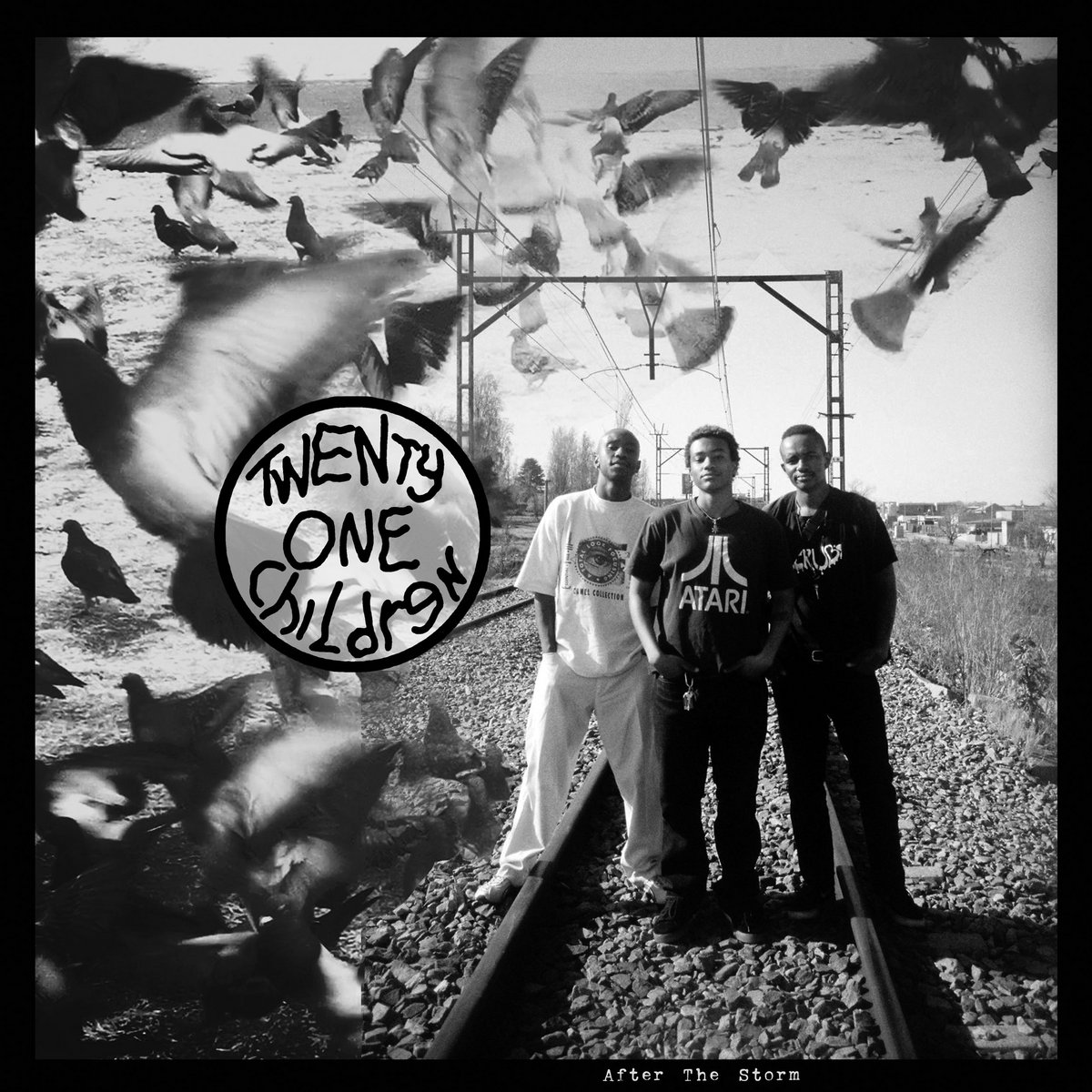
On After The Storm, Twenty One Children strip away every slick, sanitized modern production trick imaginable. The Soweto trio -- vocalist Abdula Skink, guitarist Thulasizwe Nkosi, and drummer Biko -- play fast, heavy, lo-fi punk rock that welds the raw speed of mid-'80s U.S. skatepunk to the thick rhythm of 1970s Zamrock.
Their name links back to resilience: taking root in the class size Abdula taught at an autistic school and a 21-day psychiatric stay during Thula’s road to recovery and sobriety. Now signed to Slovenly Recordings, the band is actively building the local scene on their own terms -- constructing neighborhood skate spots out of pocket, organizing benefit shows, and funding school supplies for local kids.
Between recent UK dates, playing alongside proto-punk icons DEATH in Kenya, and police constantly trying to shut down local gigs, Twenty One Children are pulling no punches. We talked with the band about skateboarding, Kwaito’s punk roots, police harassment in Soweto, and taking their sound global.
Scene Point Blank: Your sound on After the Storm completely avoids over-engineered production and sanitized studio tricks. How do you protect that raw, grit-heavy distortion from being polished away during the recording and playback process?
Twenty One Children: We stay completely hands-on and refuse to let anyone sand down our edges. During playback, if something starts sounding too clean or polite, we pull it right back into the dirt. It has to feel like the room is shaking, like you’re right there in the dust with us. We play hard, we track fast, and we keep the blood and sweat in the final mix.
Scene Point Blank: There’s a massive, physical thud in your rhythm section that feels just as much like 1970s Zamrock as it does mid-'80s U.S. hardcore. How do you balance that heavy, historic African rock groove with breakneck skatepunk velocity?
Twenty One Children: It comes naturally because both styles are rooted in pure, unvarnished energy. Zamrock bands like Ngozi Family had this heavy, rural weight to their rhythm, and U.S. skatepunk has that relentless speed. When we play, the pushing foot drives the tempo and the heavy thud holds the ground. We don't overthink the balance; we just let the African rock backbone carry the fast punk attack.
Scene Point Blank: On "Fine Wine," the jagged, minimalist guitar attack feels reminiscent of early Fugazi or the Minutemen, but it hits with an entirely localized urgency. Are those shifting, angular arrangements meticulously rehearsed, or are they born out of raw, chaotic jam sessions?
Twenty One Children: They start in total chaos during jam sessions, but then we get brutal with our playback. We sit together, listen closely, and trim away every single piece of filler until only the raw nerve is left. It’s angular because life in the hood moves in sharp turns, but it’s tight because we practice until the hand memory takes over completely.
"It has to feel like the room is shaking, like you’re right there in the dust with us. We play hard, we track fast, and we keep the blood and sweat in the final mix."
Scene Point Blank: "Rain Dance" has that frantic, cat-on-the-fretboard energy of Greg Ginn-style guitar solos. When you're pushing the speed to that absolute limit, how do you keep the song from flying completely off the rails?
Twenty One Children: You just hold on for dear life and trust each other. Biko sets the pace, and as long as that heartbeat is driving, the guitar can go as wild and off-the-rails as it wants. That feeling that the song might collapse at any second is where the best punk energy lives anyway.
Scene Point Blank: You’ve mentioned that your repetitive choruses trace back to traditional African vocal drills and rhythmic structures rather than just default Western punk tropes. Can you unpack how that cultural lineage changes the way a crowd interacts with your music compared to a standard mosh pit?
Twenty One Children: In Western punk, people often just collide and throw elbows. But traditional African music uses chant and repetition to pull the whole community into the rhythm. When we repeat those phrases over and over, it becomes a vocal drill. The pit stops being just an aggressive wall of people and turns into a shared, communal energy where everyone is chanting and moving as one entity.
Scene Point Blank: Thula, you’ve compared your style to skating through Johannesburg at high speed -- watching Bramfontein, Newtown, and the hood flash by in real time. How does the physical, architectural layout of Soweto directly dictate the tempo and aggression of your songs?
Twenty One Children: Soweto is loud, fast, and constantly moving. You step out your front door and you're immediately surrounded by noise, traffic, people, and hustle. The streets aren't smooth, so when you skate, you're constantly dodging cracks and navigating obstacles. That jagged, fast-paced environment forces our music to be just as fast, direct, and hyper-aware.
Scene Point Blank: You’ve drawn a brilliant historical line to the emergence of Kwaito music post-youth uprising, calling it "as punk as it gets" because youth used minimalist, raw tools to speak out during isolation. How does Twenty One Children carry that specific torch today?
Twenty One Children: Kwaito was created by township kids who had zero resources, [who] stripped everything down to raw loops and said exactly what they wanted to say. We do the exact same thing with electric guitars and drums. We aren't waiting for expensive gear or corporate backing. We take basic tools, make as much noise as possible, and speak directly to our lived reality in the hood.
Scene Point Blank: You've noted that overcrowding forces life outdoors, giving the community a "monopoly over storytelling." What is a specific, ground-level story from the neighborhood that made it onto the new record but might be missed by an international listener?
Twenty One Children: When houses are small, your whole life happens out on the street -- you see every argument, every celebration, every police encounter, and every neighborhood character. A track like "SCAB" comes directly from watching local cops harass kids on the corner just for standing outside. To an outsider, it's a general anti-police song, but for us, it's about specific officers we see every single afternoon in Soweto.
Scene Point Blank: "SCAB" is a blistering anti-police anthem. Between the daily reality of local corruption and authorities regularly trying to shut down DIY gigs in the neighborhood, how do you handle that blue-uniformed pressure when you're just trying to play for the kids in Soweto?
Twenty One Children: In the hood, police harassment isn't a theoretical debate; it's an everyday obstacle. Cops will try to shut down benefit shows, hassle kids skating in the street, or demand bribes. "SCAB" isn't us trying to fit a classic punk trope -- it's a direct response to real blue-uniformed pressure on our community. Rebellion for us means standing our ground, keeping our events open, and calling out that corruption to their faces.
"That feeling that the song might collapse at any second is where the best punk energy lives anyway."
Scene Point Blank: The acoustic closer "Kasi Ghost Stories" is a total left-turn -- skeletal, haunting, and addressing real-world township struggles like clinical corruption and manufactured hardships. Why was it important to end a furious hardcore EP on a note of stark, quiet vulnerability?
Twenty One Children: After blasting people with fast drums and heavy distortion, stripping everything away forces the listener to sit directly with the words. "Kasi Ghost Stories" is about real struggles -- malaria, corruption, and living in "Hell City." If we played it at breakneck speed, the heavy reality of those lyrics might get lost in the mosh pit. Ending softly makes the sting last much longer.
Scene Point Blank: You’ve been transparent about using punk as an "ointment" for trauma, balancing heavy themes with high-energy music. You compared this approach to stand-up comedians who use performance to help people observe heavy realities with ease. How hard is it to maintain that balance without letting the darkness take over?
Twenty One Children: It takes constant work and total honesty with each other. If you bottle up the darkness, it destroys you. But when you put it on stage, scream it out, and turn it into a high-energy performance, you take away its power over you. We laugh, we play fast, and we use the music to process the pain so it doesn't consume us.